


Darts Buying Guide
Why Choosing the Right Darts Matters
Whether you're a complete beginner looking to start playing darts at home, or you're a seasoned pro looking to sharpen your game, the right set of darts can make a huge difference to your performance at the oche and your overall enjoyment of the sport.
Darts, sometimes casually referred to "arrows"; vary in weight, material, grip and barrel shape. Each detail and property of the dart will change how it feels in a player's hand and how it travels in the air. Whilst many players will admit that finding the perfect dart comes down to a process of trial and error, understanding the basics before you invest in a set of darts can save you money and help you to choose equipment that best suits your style and level of play.
At Net World Sports, our PINPOINT range of darts and darts equipment has been designed with every type of darts player in mind. From beginners testing the waters with affordable darts, to serious players who want to use the very best tournament-grade tungsten barrel darts, we’ve got you covered.
Anatomy of a Dart
Each dart has 4 key parts to it:
- Point/Tip - the part that hits and penetrates the dartboard. Usually made of steel or nickel.
- Barrel - the heaviest & thickest part. Where a player grips the dart.
- Shaft/Stem - connects the barrel to the flight.
- Flight - stabilises the dart in the air. Shape & size influence the flight path/trajectory and accuracy.
Even a small difference in 1 element of the dart can have a huge impact on the flight, changing how the darts behave in the air and upon impact with the dartboard.

Dart Dimensions & Weights
There are no specific dimensions or weights when it comes to darts, although typically most darts follow the same common measurements.
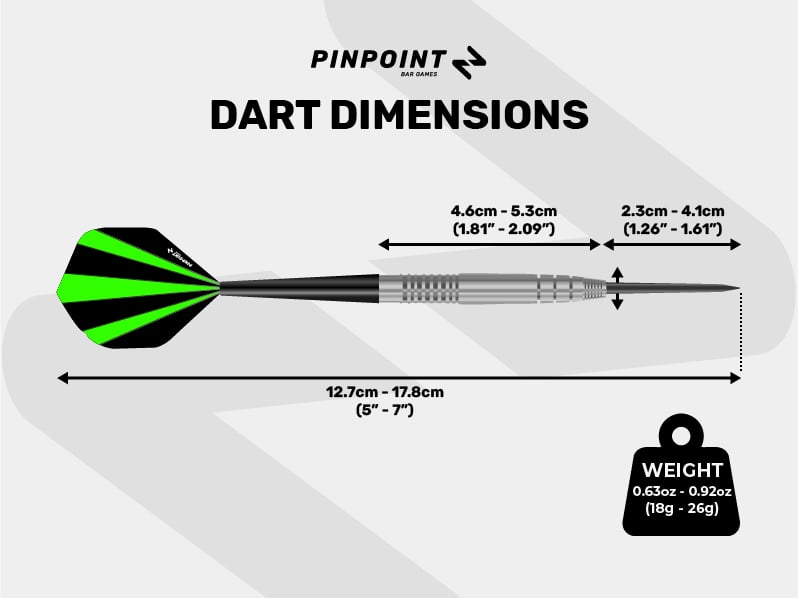
- Length: The length of most darts ranges from 5 to 7 inches (12.7cm to 17.8cm)
- Barrel Length: The barrel length typically ranges from 1.81 to 2.09 inches (46 to 53mm).
- Point Length: The point or tip is usually 1.26 inches to 1.61 inches (23mm or 41mm) long.
- Weight: The most common weight range for darts is between 18 and 26 grams (0.63 and 0.92 ounces).
Please note that these are general guidelines, and the length and/or weight of some darts may not fall within these ranges. Ultimately, the best dart for you will come down to personal preference and playing style - which will be established as you gain experience and accumulate hours at the oche. Figuring out what weight darts you like and the length/shape you prefer will help you improve your performance and obtain your full potential as a darts player.
Steel Tip vs. Soft Tip Darts
Dart tips, also called “points”, come in two main varieties: sharp metal tips, and soft tips.
Steel or Nickel Tip Darts - traditional and standard type of darts used in regulation games and tournaments. They are used on standard bristle dartboards like the PINPOINT Classic Tour Dartboard and the PINPOINT World Series Dartboard. They’re heavier than soft tip darts and give an authentic feel that is suitable for practice and competitive play.
Soft Tip Darts - ideal for young players and beginners, soft tip darts are safer and lighter than traditional darts. They provide consistent and accurate throws, but are easier for youngsters to throw and reach the board. The PINPOINT Soft Tip Darts have plastic tips which minimise the risk of injury and minimise the damage caused by wayward darts landing on or in the walls or items near the dartboard.


Dart Materials
Dart players have a choice of three primary materials for their dart barrels: tungsten, brass, and nickel-silver. Each material offers a unique blend of performance, durability, and cost.
Brass Darts - affordable, slightly bulkier than other materials, brass darts are ideal for beginners.
Nickel-Silver Darts - durable and slimmer than brass darts, nickel-silver darts offer a balance of value for money and performance.
Tungsten Darts - the gold standard of darts materials. Tungsten darts have slimmer barrels. An exceptionally dense and hard type of metal, tungsten darts are slimmer than other types but the same weight. The compact and slim diameter of the darts means that top-level players can group their darts more tightly on the board. Offering superior weight distribution and the highest level of durability, tungsten darts are a long term investment.

DART BARREL GRIPS
When playing darts there are 5 main types of dart barrel grips; Smooth, Knurled, Ringed, Micro and Razor.
Smooth grip darts – a smooth dart barrel with minimal grip for effortless release. Grip level = 1
Knurled grip darts – a knurled dart barrel typically has cross-hatch etching on the barrel to offer a modest level of grip. Grip level = 2
Ringed grip darts – a ringed dart barrel has rings cut into the barrel to create a medium level of grip. Grip level = 3
Micro grip darts – a micro grip barrel has tightly spaced grooves/ridges etched into the barrel to create a grippy dart. Grip level = 4
Razor grip darts – a razor grip dart barrel is made up of sharp, finely milled grooves that create the highest level of grip. Grip level = 5

Beginners often benefit from darts with a moderate grip, such as a ringed or knurled grip. These patterns provide sufficient friction to ensure a secure hold without being overly ‘grippy’. As players gain experience, they may prefer a completely smooth grip that has no friction. On the flip side, some may prefer a more pronounced grip, like a micro or razor grip, to enhance control and precision, whilst others stick with darts that offer a moderate amount of grip. Professional players often opt for highly customised darts with specific grip patterns tailored to their individual preferences.
DART BARREL SHAPES
Dart barrels come in various shapes, and each has its own pros and cons. Once again, you’ll need to experiment with different barrel shapes to find out which you prefer. Below we’ve outlined the different shapes available:
- Straight Dart barrels - a classic, simple barrel shape with a uniform diameter and even weight distribution. The most popular shape.
- Bomb Dart Barrels - a short barrel which is typically quite chunky/wide throughout.
- Torpedo Dart Barrels – another compact barrel but tapered and not as wide as bomb dart barrels.
- Scallop Dart Barrels – feature an indented section with grooves or scallops for consistent finger placement.
- Tapered Dart Barrels – the barrel gradually narrows towards the shaft.
- Stealth Dart Barrels – a slim and aerodynamic barrel that is thin at the front and thicker at the back.

OUR RECOMMENDATIONS ON WHICH DARTS TO BUY
As we’ve already covered, there are plenty of darts to choose from and personal preference plays a big part when choosing which darts to buy. The below is designed to serve as a rough guide.
For beginner dart players, it is important to focus on getting darts that are comfortable in your hand and affordable. Typically, these darts will help you get a feel for the game and allow you to practice throwing techniques without spending too much. As you play more, you’ll begin to develop a preference on what weight darts you like, the barrel grip types you prefer etc.
- Weight: 22-24 grams
- Materials: Brass or nickel-silver
- Grip: Straight barrel with a simple grip pattern

As players progress to intermediate and expert levels, they tend to explore tungsten darts and lighter weights to achieve greater accuracy and control. Using different types of darts as a beginner will allow you to figure out which darts you like prior to investing in a set of darts you plan to use long-term.
- Weight: 18-22 grams
- Material: Nickel-Silver or Tungsten
- Grip: Tailored or straight barrel with a more complex grip

Ultimately there are many things to consider when buying darts, which is why we always recommend trying different darts to figure out which are best suited to you.
The weight distribution of a dart can have a big impact on performance (as explained above), and the weight of the dart can very much depend on the barrel material you choose.
The same applies to dart barrel shapes and grips. Dart barrels can be front-loaded, back-loaded, or evenly weighted. Front-loaded barrels, with more weight at the front, offer stability but can be less forgiving. Back-loaded barrels, with more weight at the rear, can stabilise the flight but require precise technique. Evenly weighted barrels are a good starting point for beginners, providing a balance of control and stability. As you gain experience, experiment with different weight distributions to find your optimal setup.
Whether you're a novice or a seasoned pro, there's a perfect dart out there for you. To find your ideal dart, experiment with different types and practice regularly. Our Pinpoint range offers soft-tip, brass and tungsten darts as well as a wide selection of other darts equipment including dart boards, stands, mats, cabinets and dart cases. Start your darts journey today and discover the perfect dart for you!


