FORZA W100 WOODEN HOCKEY STICKS
- Mulberry wood with triple fibreglass
- Standard bow design for all round play
- Available in 5 sizes
- Excellent value for money
- Perfect for junior players & beginners


07 3911 1985 Here to help!
Checkout using your account
Checkout as a new customer
Creating an account has many benefits:

Buying your first hockey stick, or buying a stick for a loved one, can be a confusing task. There are dozens of options including brands, lengths, weights, bows and materials. It can be overwhelming if you are completely new to the sport, or haven't played for decades.
In this guide we will explain everything and break it down so by the end you'll have a comprehensive understanding of field hockey sticks. From stick size and weight, to the shape of the head and bow design, below is everything you need to know to pick the right stick for your game.
Every regulation field hockey stick has three main parts - the handle, the bow and the head.
The handle, often referred to as the "shaft" or "grip" is the 'straight end' of the stick that a player holds during play.
The bow is the curve in the stick. A bigger bow gives you more power, while a smaller bow improves accuracy.
The head sits at the bottom of the stick. The head is flat on one side and rounded on the other. The flat side, also known as "the face" is where you strike the ball.
The head can be split into two areas: the heel and the toe. The heel sits at the base of the stick. The toe is the curved end of the stick that protrudes, like a big toe. This is the part which most commonly makes contact with the ball.

To accommodate for people of different sizes, and for different playing preferences, hockey sticks come in a range of lengths. As you would expect, junior players have shorter sticks - and generally the taller someone is, the longer the stick you need will be. A simple way to check the stick is the right size for you, is to hold the stick vertically, next to your body with the toe touching the floor. If the top of the stick's handle reaches your hip - it's usually about the right size.
Long sticks help with reach and power.
Shorter sticks are better for dribbling, control and agility.
We’ve created a full Hockey Stick Size Guide here to help you find the perfect fit.
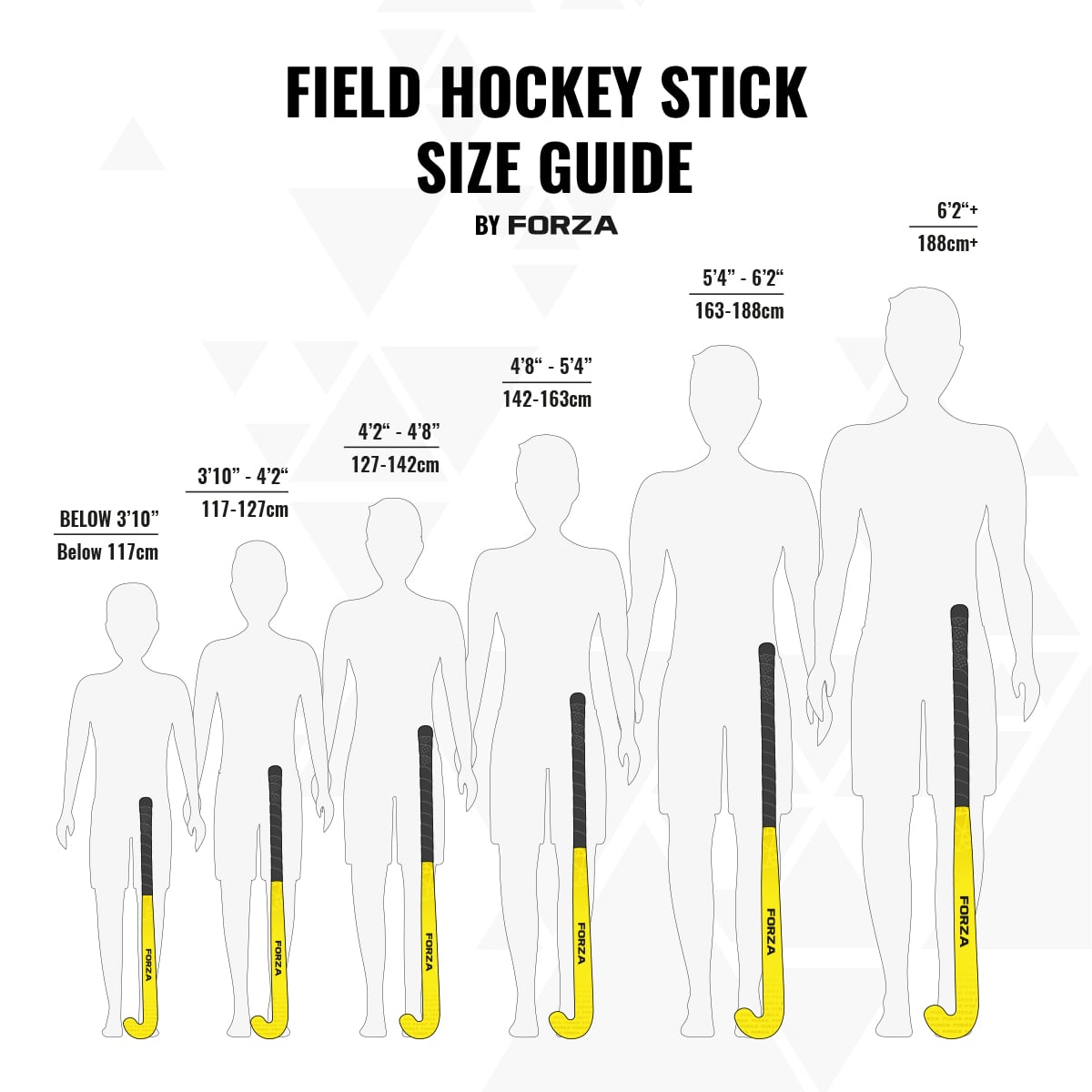
Most senior hockey sticks weigh between 535g and 625g (18.9oz-22oz). The official limit is 737g.
A lighter stick makes it easier (for most players) to dribble and change direction quickly.
A heavier stick generates power and adds force to shots and passes.
Junior sticks are lighter to suit the physical strength and size of children.
Since field hockey was codified and the first official field hockey club was established in England in the mid 19th Century - hockey sticks have always been made of wood. Ancient forms of a similar hockey-style game using sticks and a ball that existed in Egypt and Persia, also used wooden sticks. As material science evolved, eventually, so did the hockey stick. In the 1960s the first synthetic and 'non-wooden' sticks were introduced.
The first synthetic sticks used wood, with a fibreglass exterior. This made them lighter, more durable and stronger. In the late 1980s carbon fibre field hockey sticks entered the market. As the technology and material science improved; the carbon sticks became lighter and stronger; carbon sticks become popular and used by most top professional players. Top professional and elite field hockey players tend to use composite hockey sticks - made from a blend of carbon fibre and kevlar.
Wooden hockey sticks offer the best value for money. Wooden sticks are popular with children and beginners. Wooden sticks weigh more than carbon or fibreglass sticks. Some players state that heavier sticks offer more power when shooting and tackling. Wooden sticks do tend to wear out quicker than fibreglass or carbon sticks.
FORZA W100 Hockey Sticks use mulberry wood reinforced with fibreglass. This mix adds strength and boosts performance beyond traditional wood.
Fibreglass sticks are lighter and more powerful than traditional wooden sticks. Fibreglass sticks are said to offer a higher level of control, and offer a high level of performance at a reasonable price. Not as stiff or light as carbon sticks, fibreglass strikes a good balance of power and control. Fibreglass itself, is very strong and flexible, and can stretch more than carbon without breaking. The lighter, more flexible material, provides more comfort and can reduce the fatigue on a player's arms and grip.
The FORZA F100 hockey stick is made entirely from fibreglass. It offers excellent control and a comfortable PU grip for better handling.
Carbon hockey sticks are the choice of the vast majority of elite players. Carbon sticks are stronger and lighter than wood or fibreglass sticks. The strength allows more power to be transferred from the stick to the ball.
Beginners may find carbon hockey sticks harder to use than wood or fibreglass sticks. Carbon sticks tend to be stiffer, which can make hand injuries more likely for beginners and children. Carbon sticks also break more easily than fibreglass. However, to combat this many manfacturers mix carbon with a small amount of kevlar to boost durability.
Scientific studies have in fact shown that the stiffness of carbon hockey sticks, correlates with more power being transferred to the ball. This in turn can increase the speed of a shot by 10% compared to wood sticks.
FORZA C95 Hockey Sticks are made with 95% carbon. Reinforced with kevlar, the C95 composite hockey sticks provide power and strength, combined with a high level of durability.

| Hockey Stick Recommendations by Skill Level | |
|---|---|
| Skill Level | Recommended Stick Type |
| Beginners | Wood or fibreglass – affordable, easy to control |
| Intermediates | Fibreglass or low-carbon blends – balanced performance |
| Advanced | High-carbon sticks – maximum speed and power |
The bow is the curve from the handle down to the toe. Most sticks have a bow depth between 20–25mm. The more pronounced the curve, the easier it is to lift the ball for drag flicks or aerials. A flatter stick offers more control for passing and tackling.
Low Bow – the 'deepest' bow. Sharper curve close to the head. Great for drag flicks, aerials and advanced skills.
Mid Bow – gradual curve for balance and all-round play. Popular with defenders and midfielders.
Pro Bow – sits between low and mid. Offers both control and power, making it versatile for most positions.
| FORZA Hockey Stick Bow Designs | ||||||
|---|---|---|---|---|---|---|
| Product | Product Image | Bow Point | Material | Head Shape | Features | Use |
| LOW BOW |  |
200mm 24mm bend |
95% Japanese Carbon 5% Kevlar Aramid |
Hook – toe of the head crooks slightly to create a pocket for the ball. | Tapered Slim Head | Aerials, drag flicks, 3D skills & maneuverability |
| PRO BOW |  |
300mm 24.5mm bend |
95% Japanese Carbon 5% Kevlar Aramid |
J Head – Larger playing surface which offers better control | Thick Edge Hitting Zone | Handling & power. Large surface area to stabilise contact with ball. |
| MID BOW |  |
415mm 22mm bend |
95% Japanese Carbon 5% Kevlar Aramid |
Midi – Shorter than J Head. Suits a quick stick. | Thick Edge Hitting Zone | All round performance |
Low bow hockey sticks have a bend with a depth that is typically 24mm. The arc is situated relatively close to the stick’s toe, at approximately 200mm from the stick base, with a more acute/sharper angle than other designs. It’s this close proximity to the base of the stick, lower down than other designs, that gives it the name “low bow”.
Allowing for a greater "sling" of the ball, low bow hockey sticks are great for players who regularly perform drag-flicks and aerial passes or shots. The low position of the arc provides a greater "loft angle" and the ability to get the ball in the air.
With this "deepest" bow design, experienced players can enhance their drag-flicks and aerial shots without hindering the ability to hit low passes and shots. If you are a forward who likes to perform flicks and shoot for the top-corners of the goal, then a low bow stick is a wise choice. A study titled “Kinematic analysis of the drag flick in field hockey” highlights that achieving high stick-head speed is crucial for a powerful drag flick and that:
"The deeper bow enables a more efficient transfer of energy and improved velocity"
Quote source
Mid bow hockey sticks have a more gradual, less pronounced arc than other designs. Using a more traditional design that is great for all round performance, mid bow hockey sticks are popular with midfielders and defenders who look to intercept and block the ball frequently.
Predictable and consistent, the shape of a mid bow hockey stick changes gradually along the length of the stick. The mid bow is great for any player with a "quick stick" style of play. If you are a defender or midfielder that likes to tackle, intercept and pass the ball along the ground, then a mid bow stick is a great option.
Pro bow hockey sticks have arcs that are not as angled as low bows, but not as long and gradual as mid bows. They are effectively a “happy medium” between the 2 designs.
Pro bow hockey sticks possess a larger playing area which makes them ideal for dribbling, control and power. The balanced performance offered by pro bows makes them ideal for players looking to perform flat shots and passes, in addition to aerial shots. A great all-around stick for intermediate and advanced-level players.

The head design changes how you trap, dribble and strike the ball.
Hook – larger curve that forms a pocket. Popular with attackers who dribble and flick.
J Head – bigger surface area for control and interceptions. Favoured by midfielders and defenders.
Midi – shorter head for quick stick play. A good all-round option.
Shorti – once common, now rarely used at elite level.

No. All sticks are made for right-handed use, even though both hands grip the handle. All sticks have to be flat on the left side, effectively making them for right-handed players only. Despite this, there are a relatively large number of left-handed elite players who excel by adapting their technique. They often have a more unpredictable and creative style than the average right-handed player.
No. Only the flat side can touch the ball in regulation play. Using the rounded side is a foul. Allowing players to use both sides of the stick would increase the risk of dangerous swings and collisions. Backhand strokes would be particularly dangerous if players could use both sides of the hockey stick.
Keeping your hockey stick in good condition is simple but important. Wipe it down after use to remove any dirt, sand or moisture. Avoid any soaking of the stick and don't leave it in a damp kit bag or the car as moisture can weaken materials. Check the grip regularly and replace it when it wears down and the tackiness is reduced. Check the manufacturer's instructions on how best to deal with small chips and/or cracks and store your stick in a cool, dry place, away from direct sunlight.
What Hockey Stick Should I Buy for a Kid?
When buying a hockey stick for a child, the most important factors are size, weight, and material. A stick that’s too long or heavy can hinder technique cause frustration and increase the risk of injury. Research shows that junior players have less upper body strength and coordination than adults, so lighter sticks are crucial for safe skill development and enjoyment. Wooden or fibreglass sticks are ideal for juniors because they are durable, affordable, and easier to control than stiff carbon sticks. The FORZA W100 Wooden Hockey Sticks (mulberry wood with fibreglass reinforcement) are perfect for beginners and come in 5 sizes. FORZA F100 Fibreglass Hockey Sticks provide lightweight handling and extra control for kids progressing in the sport.
At Net World Sports Australia, we stock a full range of hockey sticks for players of all ages and ability-levels. From durable wooden sticks to fibreglass and elite-level carbon, there’s something for every player and every budget.
We also supply a comprehensive selection of field hockey equipment, including hockey training equipment, hockey bags, hockey goals and hockey balls.


