

Pickleball Paddle Buyer's Guide
Pickleball Paddle Sizes, Designs & Materials
Pickleball is one of the fastest growing sports in the world. A fun game that can be played seriously, or just for fun, it has something to offer almost everyone. Easy to learn, but hard to master, the game is highly addictive and all ages can play. If you are already a fan of pickleball, and you are looking to invest in your own pickleball paddle, then this guide will help you to understand the key differences in pickleball paddle sizes, materials, designs and grip types. Armed with this knowledge, you will be able to make an informed choice when purchasing your first paddle.
Paddle Dimensions & Regulations
According to USA Pickleball (formerly known as USAPA), the total length of a pickleball paddle should not exceed 43.18cm (17 inches). In addition, the length, added to the total width, should not exceed 60.96cm (24 inches). So for example if the length of the paddle is 43.18cm (17 inches), the width cannot exceed 17.78cm (7 inches). In practical terms, this means that if you were to choose a paddle with an elongated, longer face, the paddle face would have to be slimmer than a traditional design.
The standard, traditional design of a paddle with a thicker face offers a good balance of power and control. Elongated paddles provide additional reach but there are some trade offs in terms of control and the size of the paddles sweet spot. The table below summarises the key differences between the two main types of paddle:
| Traditional vs Elongated Pickleball Paddles – Pros & Cons | ||
|---|---|---|
| Feature | Traditional Paddle | Elongated Paddle |
| Reach | Standard | Much greater |
| Power & Leverage | Moderate | Greater |
| Sweet Spot Size | Larger and lower | Smaller and higher |
| Maneuverability | Greater | Can be reduced |
| Forgiveness / Mishits | More forgiving | Less forgiving |
| Weight & Fatigue | Lighter, less fatigue | Possible fatigue due to higher swing weight |
| Ease for Beginners | Ideal | Less recommended |
| Cost | Lower | Typically higher |
| Spin Potential | Standard | Often enhanced |
| Best For | Beginners, doubles play, control-focused | Experienced players seeking reach and power |
To help you visualise the differences between standard and elongated paddle designs, the diagrams below show the typical dimensions of each. These annotated graphics highlight width and length measurements. Displaying the different paddle designs side-by-side, should help you to understand the key differences between the shapes and the best fit for their specific playing styles.


Pickleball Paddle Size Comparison

Pickleball paddles are larger than table tennis bats/paddles, but smaller than tennis rackets and squash rackets. All paddles and bats have a solid face, rather than the string design that is seen with rackets.
Interestingly, the rules of table tennis state that the bat/paddle “may be any size, shape, or weight”, meaning that in theory a table tennis bat could be any size you wanted as long as the blade is “flat and rigid”. So according to the rules, you could use a giant or tiny table tennis bat if you wanted to!
Despite the lack of specification outlined in the official rules, most table tennis bats are 25.4cm (10.0 inches) long and 15.0cm (5.9 inches) wide. They are also significantly lighter than pickleball paddles, with a weight of around 85g (3oz).
Compared to tennis rackets, Squash rackets have a similar length of 27 inches (68.6cm) and a maximum width of 8.46 inches (21.5cm). Pickleball paddles and table tennis bats both have a solid face, whilst tennis rackets and squash rackets have taut strings that criss-cross vertically and horizontally within the racket frame.
Pickleball Paddle Weight
There’s no official weight limit, but most paddles range between:
- 7.2 oz – 8.5 oz (204g – 241g)
- Lighter paddles: Better control and speed, ideal for finesse play.
- Heavier paddles: Offer more power and stability.
- Mid-weight paddles: Best of both worlds, perfect for beginners.
| Paddle & Racket Size Comparison | |||
|---|---|---|---|
| Paddle/Racket | Approx. Length | Approx. Width | Weight |
| Pickleball Paddle | 15–16 in | 7–8 in | 7.2–8.5 oz (204–241g) |
| Table Tennis Bat | ~10 in | ~6 in | ~3 oz (85g) |
| Tennis Racket | 27 in | 10.6 in | 9–11 oz |
| Squash Racket | 27 in | 8.5 in | 4–6 oz |
Understanding how pickleball paddles compare in size and weight to other paddles, rackets and bats, gives useful perspective; especially for those transitioning from tennis, squash, or table tennis. Now that you're familiar with paddle dimensions, let's explore another important factor in paddle performance: finding the right paddle grip size.
Choosing the Right Grip Size
It’s quite important to get a paddle with the correct handle/grip size. If you are thinking of playing regularly then using an incorrectly sized handle can lead to chronic injuries including tennis elbow and bicep tendonitis. Using a paddle with the correct grip size will also allow you to distribute force and control your shots more easily.
- Hold your hand flat with your fingers together.
- Measure from the bottom palm crease to the tip of your ring finger.
- Use this number to match a grip size (see chart).

In the image shown above the grip would be 4.5 inches, which equates to a size 4 pickleball paddle.
Once you have measured your hand, you can use the table below to determine which size of paddle you require:
| Pickleball Grip Size Chart | |||
|---|---|---|---|
| Size in inches | Size in cm | European Sizes | US Sizes |
| 3.94" - 4.06" | 10.0 - 10.3cm | 0 | 4 inches |
| 4.06" - 4.17" | 10.3 - 10.6cm | 1 | 4 ⅛ inches |
| 4.17" - 4.33" | 10.6 - 11.0cm | 2 | 4 ¼ inches |
| 4.33" - 4.45" | 11.0 - 11.3cm | 3 | 4 ⅜ inches |
| 4.45" - 4.65" | 11.3 - 11.8cm | 4 | 4 ½ inches |
| 4.65" - 4.72" | 11.8 - 12.0cm | 5 | 4 ⅝ inches |
| 4.72" - 4.84" | 12.0 - 12.3cm | 6 | 4 ¾ inches |
Parts of a Pickleball Paddle
When choosing a pickleball paddle, it really helps to know what all the different parts of it are called. This allows you to judge if the design and specifications are right for you as a beginner, or as an experienced player looking for a certain type of paddle to suit your style.

Face - Striking surface - used to hit the pickleball; often made of graphite, fibreglass, or wood.
Edge Guard - Protects the outer rim from impact and helps maintain the shape of the paddle.
Throat - Connects the paddle face to the paddle handle. It is usually made of the same material as the face of the paddle.
Handle - Main grip area, often cushioned for comfort.
Grip Tape - Outer wrap of the handle. Pickleball paddle grips are usually made of rubber or a synthetic material such as polyurethane (PU).
End Cap - Base of the handle, adds control and protects structure. Also known as the "butt cap".
PADDLE MATERIALS & CORE
Pickleball paddles are made from a range of materials. These materials include fibreglass, wood and carbon fibre. Carbon fibre is popular with experienced players as it offers a greater level of control and precision than fibreglass and wooden paddles. Carbon fiber paddles are also able to generate a large amount of power, despite being lightweight. The lightness of carbon fibre is also an advantage, as it helps prevent a player’s grip from becoming fatigued.
Wooden paddles are great for beginners or those looking for a budget friendly pickleball paddle. For example, if you are looking to give the sport a try and purchase pickleball paddles for the backyard, then hardwearing and robust wooden paddle are a good choice. Wooden paddles are heavier but they are just as durable and hardwearing as fiberglass and carbon polymer materials.
Face Materials
- Graphite/Carbon Fibre: Lightweight, great control, preferred by intermediate players.
- Fibreglass: Offers power with some flexibility.
- Wood: Budget-friendly, durable—perfect for beginners or school use.
Core Types
- Polymer Core (Honeycomb): Soft feel, great control, and quieter hits. Most popular today.
- Nomex Core: Harder and louder, used for power play.
- Aluminium Core: Lightweight but less common.
Weight
Heavier paddles weighing more than 8.5oz offer additional power, whilst lighter paddles, weighing less than 7.3oz, offer more precision & control. Most players opt for a pickleball paddle that weighs somewhere in between, for a balance of power & precision. Medium-weight pickleball paddles are ideal for beginners, who are yet to establish a specific style of play.
USA Pickleball Approved Paddles
If you plan to compete in a pickleball tournament, you will probably want to make sure your paddle is USA Pickleball approved. This will ensure that the paddle meets the most recognised governing body’s standards for competitive play. Our Vermont Imperium pickleball paddles are USAPA-certified. Designed with carbon fibre faces, honeycomb polymer cores, and perforated PU grips. They are ideal for recreational and competitive play.
| Which Paddle Should I Choose? | |||
|---|---|---|---|
| Feature | Best For | Key Benefit | Recommended Vermont Paddle |
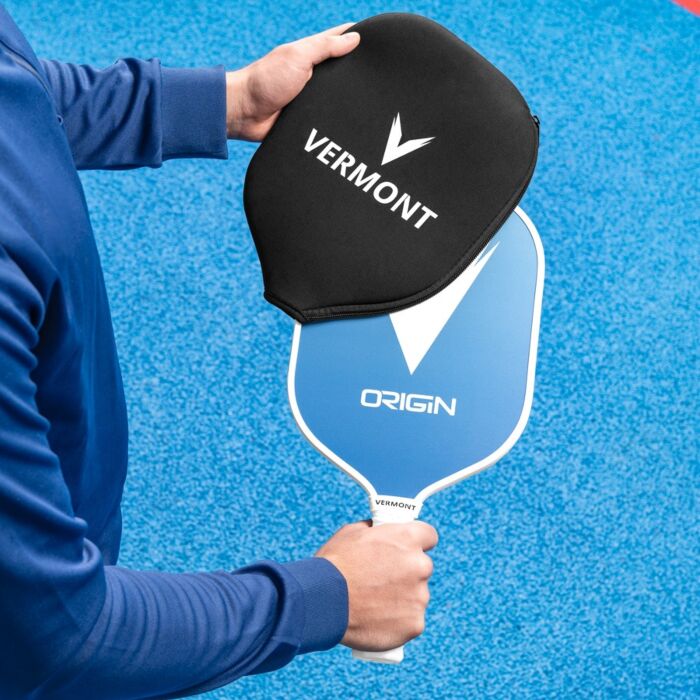
| Standard Paddle | Beginners / All-rounders | Balanced control & power | Vermont Origin Paddle |
| Elongated Paddle | Advanced / Singles play | Extended reach | Vermont Imperium E Paddle |
| Lightweight Paddle | Control-focused players | Speed & precision | Vermont Imperium T Paddle |
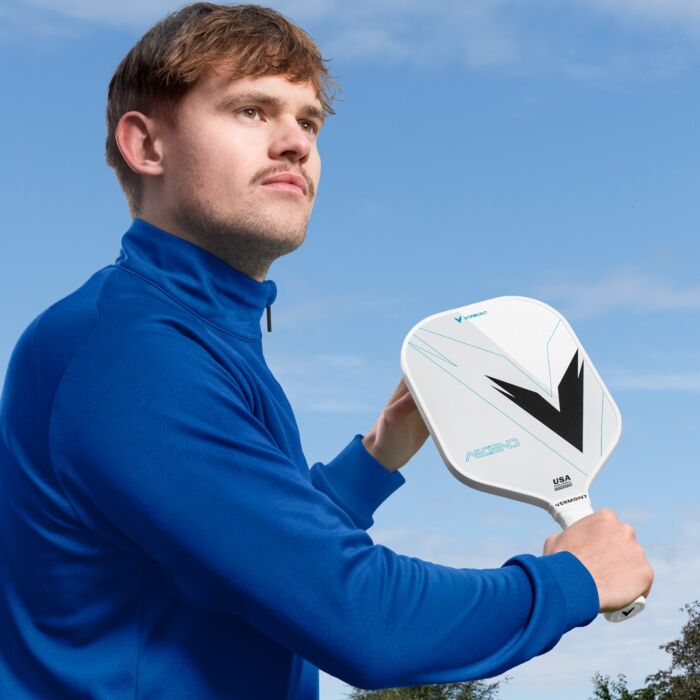
| Heavyweight Paddle | Power hitters | Strong, forceful shots | Vermont Ascend Paddle |
| Wooden Paddle | Recreational / School use | Durable & cost-effective | Vermont Wooden Paddles (Pair) |
| Square Paddle | Accuracy | Large sweet spot for consistent shots | Vermont Imperium S Paddle |
Pickleball Paddle FAQs
Q1: What's the difference between a pickleball paddle and a tennis racket?
The obivous differences between pickleball paddles and tennis rackets, are apparent at first glance - rackets have strings, pickleball paddles do not. Pickleball paddles are also significantly smaller and lighter than tennis rackets. Paddles are also lighter - typically 7-8.5oz compared to 10-12oz for tennis rackets. As a result of the design, a tennis racket is much more powerful than a pickleball paddle - especially when using a tennis ball instead of a pickleball which is less dense and larger.
Q2: How often should you replace a pickleball paddle?
For people playing 2 to 3 times per week; a mid range paddle will typically last 1-2 years before the core begins to soften somewhat and the face delaminates slightly. For those playing less regularly, paddles can last a number of years. Serious and top competitive players, will tend to replace a paddle once every 6 to 12 months. The length of time the paddle last can also depend on the style of play - heavy spin players will wear down the surface of a paddle more quickly.
Q3: Can beginners use the same paddles as advanced players?
Beginners can use advanced paddles, but it rarely helps them improve faster. Advanced-level paddles are often designed for spin, control and feel at the expense of forgiveness. A slight mishit using an advanced paddle - that hits off centre or near the edge produces less power and can rebound off the paddle at an unpredictable angle. A beginner is better served by a mid-weight (7.8–8.3oz), medium-core paddle with a larger sweet spot. The larger sweet spot is more forgiving and lets them build consistency working on more power. The exception is a player coming from tennis, racquetball or table tennis with transferable skills. Whilst the game takes some getting used to, they often have advanced hand-eye coordination that helps that hit the sweet spot consistently with a paddle.
Shop Pickleball Paddles at Net World Sports
At Net World Sports Australia, we offer a wide range of pickleball paddles for every level of play. From cost-effective, great value wooden paddles for casual games and beginners, to elite carbon fibre paddles for competitive play, you’re sure to find the perfect paddle for yourself or a loved one. Explore our Vermont pickleball paddle range, nets, posts, balls, and training gear — all designed to elevate your game!


