


SOCCER FIELD DIMENSIONS
SOCCER FIELD SIZE GUIDE
The size of a soccer field (often called a "soccer pitch") varies according to the age of the players, the number of players and the game format. Even at the professional level, 11 a-side soccer pitches vary quite significantly in terms of their length and width.
To help soccer fans, players and budding groundskeepers understand the elements of a soccer field that are consistent and those that vary, we have created this simple, visual guide. The guide includes a selection of helpful graphics and answers a range of common questions about soccer fields dimensions and line markings.
By the end of the article you will have a comprehensive understanding of the rules and regulations regarding soccer field markings, measurements and dimensions.
Scroll through the full guide or jump to a specific section using the quick-links below:
- Soccer Field Dimensions by Age
- Under 7 & 8’s Soccer Field
- Under 9 & 10’s Soccer Field
- Under 11 & 12’s Soccer Field
- Under 13 & 14’s Soccer Field
- Under 15 & 16’s Soccer Field
- Under 17s & Older Soccer Field
- High School Soccer Field Dimensions
- College Soccer Field Dimensions
- Soccer Field Dimensions by the Number of Players
- 5-a-side Soccer Field
- Futsal Soccer Field/Court
- 6-a-side Soccer Field
- 7-a-side Soccer Field
- 9-a-side Soccer Field
- 11-a-side Soccer Field
- 11-a-side Soccer Field Lines Explained
- Famous Soccer Field Dimensions
- Soccer Field FAQs
SOCCER FIELD DIMENSIONS BY AGE
Soccer Field Dimensions by Age in Australia
FIFA and Football Australia, recommend that children play on smaller soccer fields than senior players. The game format and the number of players on each team is also reduced at the youth level, with “Miniroos” - under 6 & 7 years playing 4 a side with no goalkeepers.
Youth Soccer Field Size Charts
| Football Australia – Youth Soccer Field Sizes by Age Group | |||
|---|---|---|---|
| Age Group | Game Format | Field Length | Field Width |
| Under 6 | 4 vs 4 (No Goalie) | 30m (98.4ft) | 20m (65.6ft) |
| Under 7 & 8 | 4 vs 4 or 5 vs 5 (No Goalie) | 30m (98.4ft) | 20m (65.6ft) |
| Under 9 & 10 | 7 vs 7 | 45–55m (147–180ft) | 35–45m (115–147ft) |
| Under 11 & 12 | 9 vs 9 or 10 vs 10 | 60–70m (197–230ft) | 40–50m (131–164ft) |
| Under 13 & 14 | 11 vs 11 | 82.3m (270ft) | 50.3m (165ft) |
| Under 15 & 16 | 11 vs 11 | 100–110m (328–361ft) | 64–75m (210–246ft) |
| Under 17 & Older | 11 vs 11 | 100–110m (110–120yd) | 64–73.15m (70–80yd) |
SOCCER FIELD & EQUIPMENT REQUIREMENTS BY AGE
Under 6 - MiniRoos
Under 6 As per Football Australia’s MiniRoos guidelines, Under 6 players play non-competitive 4 v 4 games with no goalkeepers. Games are usually broken into 2 x 20-minute halves or shorter quarters depending on the association and age and fitness of the children. A size 3 soccer ball is used. Recommended soccer goal size is 1.8m x 0.9m (6ft x 3ft).
The soccer field dimensions are not strictly enforced but it is recommended that the field should measure approximately:
Length: 30 metres (98.4 ft)
Width: 20 metres (65.6 ft)
There is no offside law for Miniroos and the focus is on fun, developing a positive attitude towards the sport and learning basic skills.
Under 7 & 8’s
For Under 7 & 8 players, games remain the same format as for Under 6s - 4 v 4 or 5 v 5, with no goalkeepers.
Rules including dimensions and duration are not strictly set, but games are typically split into 2 x 20-minute halves with a short 5 minute half time break.
The ball remains size 3, and goals should be 1.8m x 0.9m (6ft x 3ft).
Recommended field size is the same as Under 6:
Length: 30 metres (98.4 ft)
Width: 20 metres (65.6 ft)
The soccer field for Under 7 & 8’s games is the same size as Under 6’s with a length 30 metres (98.4 ft), and a width of approximately 20 metres (65.6 ft).
Under 9 & 10’s
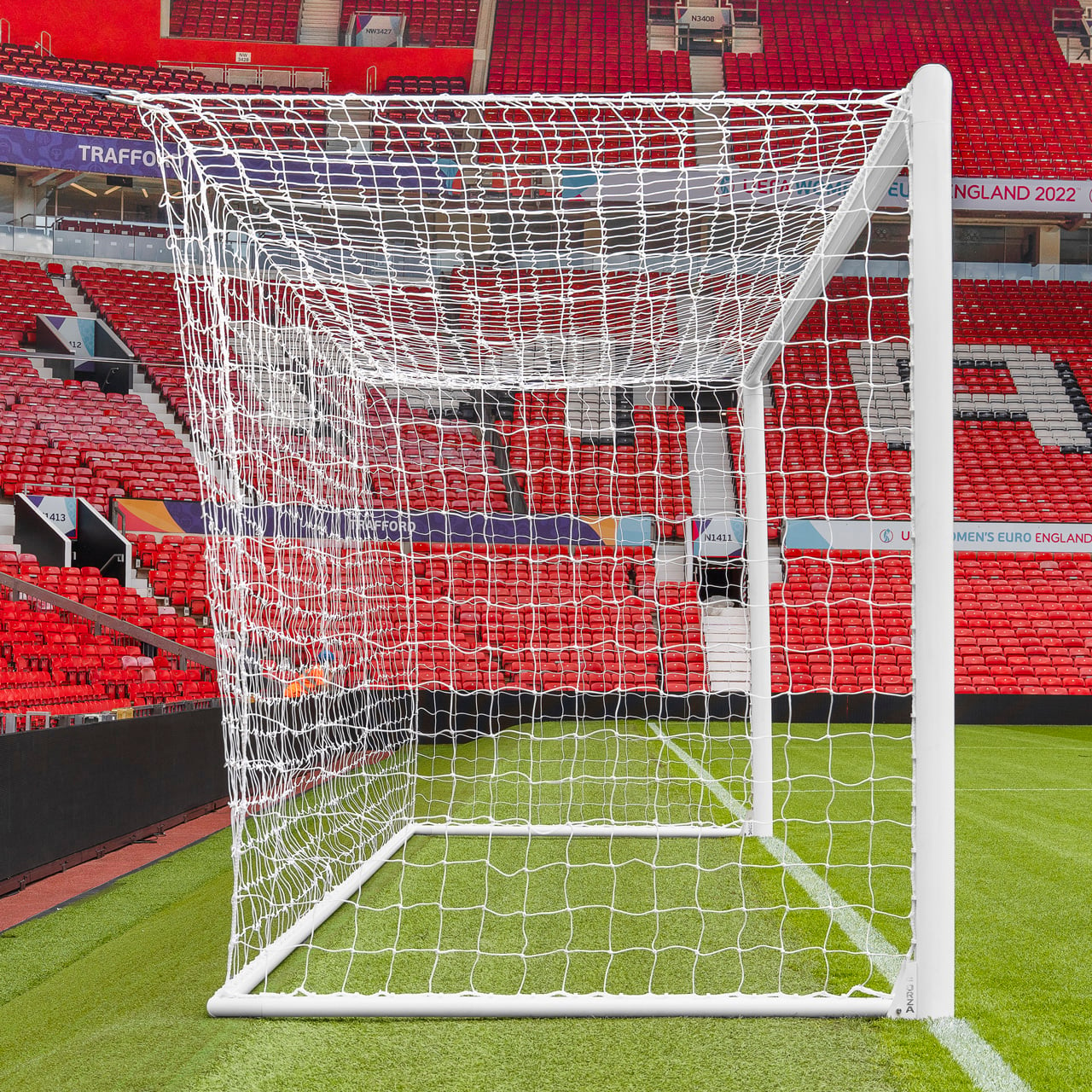
Under 9 and 10 players move to 7 v 7 formats and this includes goalkeepers. Games are played in 2 x 20-minute halves and a size 4 ball is used. The recommended goal size is 3m x 2m (9.8ft x 6.5ft).
Recommended field size:
Length: 45–55 metres (147–180 ft)
Width: 35–45 metres (115–147 ft)
Under 11 & 12’s
With an emphasis on fun still at this young age, game formats can vary. For U11 and U12, players typically play 9 vs 9 or 10 vs 10, though 11 vs 11 is also permitted depending on the competition level. The games are made up of 2 x 25 or 30-minute halves, and are played with a size 4 ball. There is no overtime or injury time added at this stage in most community leagues but overtime / extra time and penalties can be used to determine cup/tournament games in the knockout stages. The goals used are normally 5m x 2m (16.4ft x 6.5ft).
Recommended field dimensions:
Length: 60–70 metres (197–230 ft)
Width: 40–50 metres (131–164 ft)
Under 13 & 14’s
From U13 onward, players transition to full 11-a-side matches with size 5 balls. Games are typically played in 2 x 30 or 35-minute halves, depending on the association.
Goals are usually 6.4m x 2.1m (21ft x 7ft), but sometimes full size goals are used if these smaller goal posts are not available. At this age, a size 4 ball is used.
Recommended field dimensions:
Length: 82.3 metres (270 ft)
Width: 50.3 metres (165 ft)
Under 15 & 16’s
U15 and U16 games are full 11-a-side matches. The games normally have a duration of 2 x 40-minute halves. A size 5 ball is used, with standard goals full size goals - .7.32m x 2.44m (24ft x 8ft)
The field for this age group is full-size:
Length: 100–110 metres (328–361 ft)
Width: 64–75 metres (210–246 ft)
Under 17s & Older
Under 17s leagues and tournaments, have the same ruleset as senior adults. Senior football (including U17+) is played as 11 v 11, with 2 x 45-minute halves. A size 5 ball is used.
For IFAB and FIFA regulated soccer games, a senior international soccer field should be between:
Length: 100-110 metres (110-120 yards)
Width: 64-73.15 metres (70-80 yards).
| FIFA Soccer Field Size Regulations for International Senior Games | ||
|---|---|---|
| Length | Width | |
| Minimum | 105.6m (110 yards) | 64.0m (70 yards) |
| Maximum | 109.7m (120 yards) | 73.2m (80 yards) |

High School Soccer Field Dimensions
Football Australia adopts FIFA-based field dimensions for high school and senior matches. According to Football NSW and Football Victoria field standards, common dimensions used for secondary school competitions are:
Length: 100 – 110 metres (328 – 361 ft)
Width: 64 – 75 metres (210 – 246 ft)

University Soccer Field Dimensions
University sport is overseen by Unisport Australia. The official guidelines in relation to the rules of soccer/association football are the same as the FIFA rules:
“UniSport Australia (UniSport) football competitions are conducted in accordance with the Fédération Internationale de Football Association (FIFA) Laws of the Game 2024-25, except where these differ from UniSport competition guidelines; in which case the latter shall take precedence.”
This also applies to the soccer field dimensions and the goal size. As shown by the image below, the soccer fields tend to be the same size as high school soccer fields and FIFA 11-a-side soccer fields:
Length: 100 – 110 metres (328 – 361 ft)
Width: 64 – 75 metres (210 – 246 ft)

SOCCER FIELD DIMENSIONS BY THE NUMBER OF PLAYERS
Small sided football tournaments and leagues have regulations set out by organisations including the World Mini Football Federation, and the Socca Federation which regulates international 6-a-side tournaments.
In Australia, there is no single "official" dimension for a 5-a-side soccer pitch, as it's not governed by FIFA regulations like full-sized football. However, Football Australia and most recreational leagues follow widely accepted standard dimensions based on international small-sided guidelines and facility design.
In Australia, the goal area for 5-a-side soccer is usually a semi-circle. It extends 6 metres from the centre of the goal line to the edge of the area. Only goalkeepers are allowed inside this space in most games.
The centre circle should have a radius of 2.75 metres. This is used for kick-offs and restarts.
5-a-side Soccer Field Size & Markings
5-a-side soccer fields can vary significantly in size, and the dimensions will often depend on the amount of space available. Most 5-a-side games are informal and often used as a form of training during the winter for 11-a-side teams.
Some significant differences in the rules and equipment compared to 11-a-side soccer matches include:
- The ball is usually a size 4
- The ball is usually yellow and has a low bounce
- The court/pitch is normally enclosed by walls that keep the ball in play
- There is often a head-height rule - the ball cannot go above 6ft in the air
- There is no offside rule
- Only the defending goalkeeper is allowed in the penalty area
For formalised and regulated games to take place on a given 5-a-side field or court however, most international federations, including The Football Association, state that the field/court should have a:
Length of 36.5 metres (120 ft)
Width of 27.5 metres (90 ft)
The markings on a regulation 5-a-side field/court are shown in the soccer field diagram below:

As shown in the image above, the goal area is a semi circle, with a length - as measured from the center of the goal-line to the tip of the goal area, of 6.5yds (6m). In most regulated and amateur games, only the goalkeepers are allowed to step inside the area.
A 5-a-side field/court should also have a center circle with a radius of 3.0 yards (2.75m). 5 a-side goalposts, should be 3.66m × 1.22m (12ft x 4ft), although they can also be 4.88m x 1.22m (16ft x 4ft) depending on the regulations.
5-a-side soccer has no offside rule and goalkeepers typically have to feed the ball into play from the goal area, using their hands to throw or roll it to a player on their team. In most rulesets, the goalkeeper has to stay within the goal area at all times.
Futsal Court Size & Markings
Futsal games and matches are governed by FIFA and UEFA and therefore have more stringent rules in regards to the size of the field/court. Governed by laws of the game, Futsal is a popular and globally recognised and modified form of 5-a-side soccer. Unlike 5-a-side football, Futsal is played without walls or rebound walls surrounding the pitch/court sidelines and goal lines. There is an emphasis on technique and close control in Futsal and it is often used in youth development systems due to the focus on technique.
FIFA regulations state that a Futsal court for international games should be:
Length of 40 metres (131 ft)
Width of 20 metres (65.6 ft)
For non-international games, the court can have:
Length of 25-42 metres (82–138 ft)
Width of 16-25 metres (52-82 ft)
Futsal goals are also unique to the sport - 3m x 2m. The penalty area has a 6m radius, and the two penalty spots used in futsal are 6m and 10m from the centre of the goal.
6-a-side Soccer Field Size & Markings
In the United States, the largest 6-a-side soccer organization is the National Indoor Soccer League. Played on artificial indoor fields, Indoor Soccer is popular in both the US and Canada. Said to have been developed to allow soccer to be played during the winter, the sport now has an official league.
The official rules of the sport state that the field/court should be 200 feet (66.7yds) long and 85 feet (28.3yds) wide. Unlike other soccer fields, games played in the official Indoor Soccer League, must have rounded corners.
Another organization called The Socca Federation states that pitch dimensions can vary greatly for 6-a-side soccer, and games can be played on a wide variety of fields, including indoor and Astroturf surfaces.
However, for international tournaments, the guidelines for the pitch dimensions for 6-a-side tournaments, state that they be no less than 32.8yds (30m) wide by 54.7yds (50m) long -
with the recommended size being:
Length of 60 metres (197 ft)
Width of 35 metres (115 ft)
For 6-a-side games, the Socca Federation states that the minimum goal size should be 3.66m x 1.83m (12ft x 6ft).
7-a-side Soccer Field Size & Markings
7-a-side soccer is played worldwide under various rulesets and federations/governing bodies. Rules can vary depending on the competition and the country. In general however, the rules usually allow rolling substitutions, there are no offsides and the field/court is almost always significantly smaller than 11 a-side soccer fields.
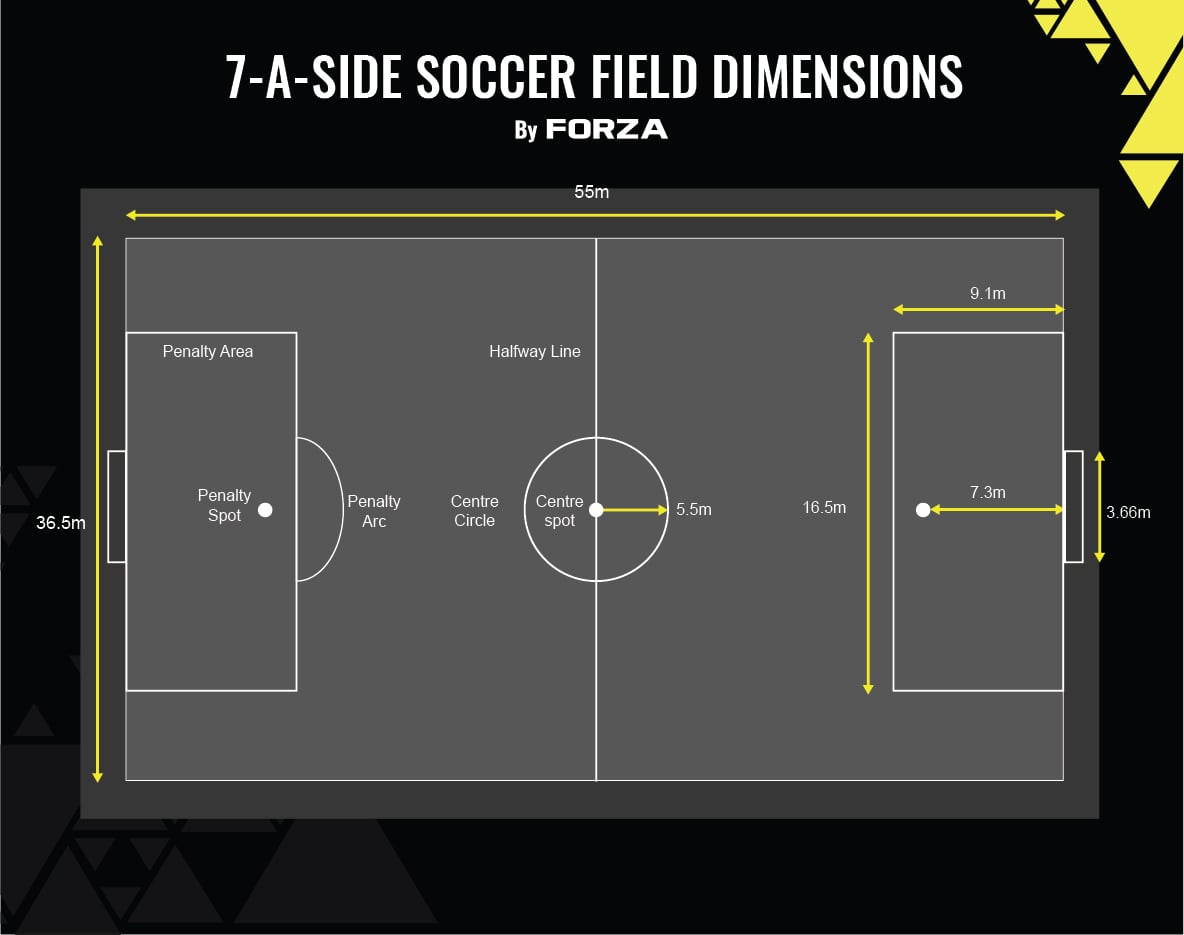
In Australia, Simplysports has a football/soccer program that involves 7 a side games, and Walking Football also uses 7-a-side games with a recommended pitch length of 50-60m x 30-40m. The International Football Association states that 7-a-side soccer fields should be:
Length of 45-55 metres (148–181 ft)
Width of 25m-35 metres (82–115 ft)
Goalposts used in 7-a-side games are usually 3.66m x 1.83m (12ft x 6ft).
International 7-a-side tournaments include World Sevens Football and Football 7 holds various competitions each year.
9-a-side Soccer Field Dimensions
9-a-side soccer is a common format in Australia, especially in youth development programmes. There are also senior organisations such as Social Football Australia, which holds games and tournaments with 9-a-side teams.
Field sizes can vary depending on the competition or local rules. Football Australia recommends a field size with:
Length of 73 metres (239.50 ft)
Width of 45 metres (147.64 ft)
Goal size varies, with some organisations using goals that are 6.4 metres wide by 2.1 metres high (21ft x 7ft), whilst others use full size goals which are 7.3m x 2.4m (24ft x 821ft).

11-a-side Soccer Field Dimensions
Following the official Laws of the Game, set out by IFAB (International Football Association Board), the standard soccer field size for 11-a-side games is:
Length of 100.6 metres (330 ft)
Width of 64.0 metres (210 ft)
100.6m x 64.0m (110yds x 70yds). Although most football/soccer governing bodies will allow variation in the length and width of the fields, especially at the amateur level.
In Australia, local and recreational matches have much less stringent guidelines in terms of the soccer field dimensions. IFAB recognises that it’s difficult for amateur football/soccer teams to follow exact specifications, and officially allow the field length to vary from 91m to 120m long with a large width variation allowed - 45m to 90m.
The goal posts should be ‘full size’ - 7.32 metres wide and 2.44 metres high (24ft x 8ft).
| 11-a-Side Soccer Field Size Guidelines (Australia & IFAB) | ||
|---|---|---|
| Authority / Use | Length | Width |
| Football Australia (recommended) | 100m - 110m (328ft - 361ft) | 64m - 75m (210ft - 246ft) |
| IFAB (International Matches) | 100m - 110m (328ft - 361ft) | 64m - 75m (210ft - 246ft) |
| IFAB (Amateur/Domestic Matches) | 91m - 120m (298ft - 394ft) | 45m - 90m (148ft - 295ft) |
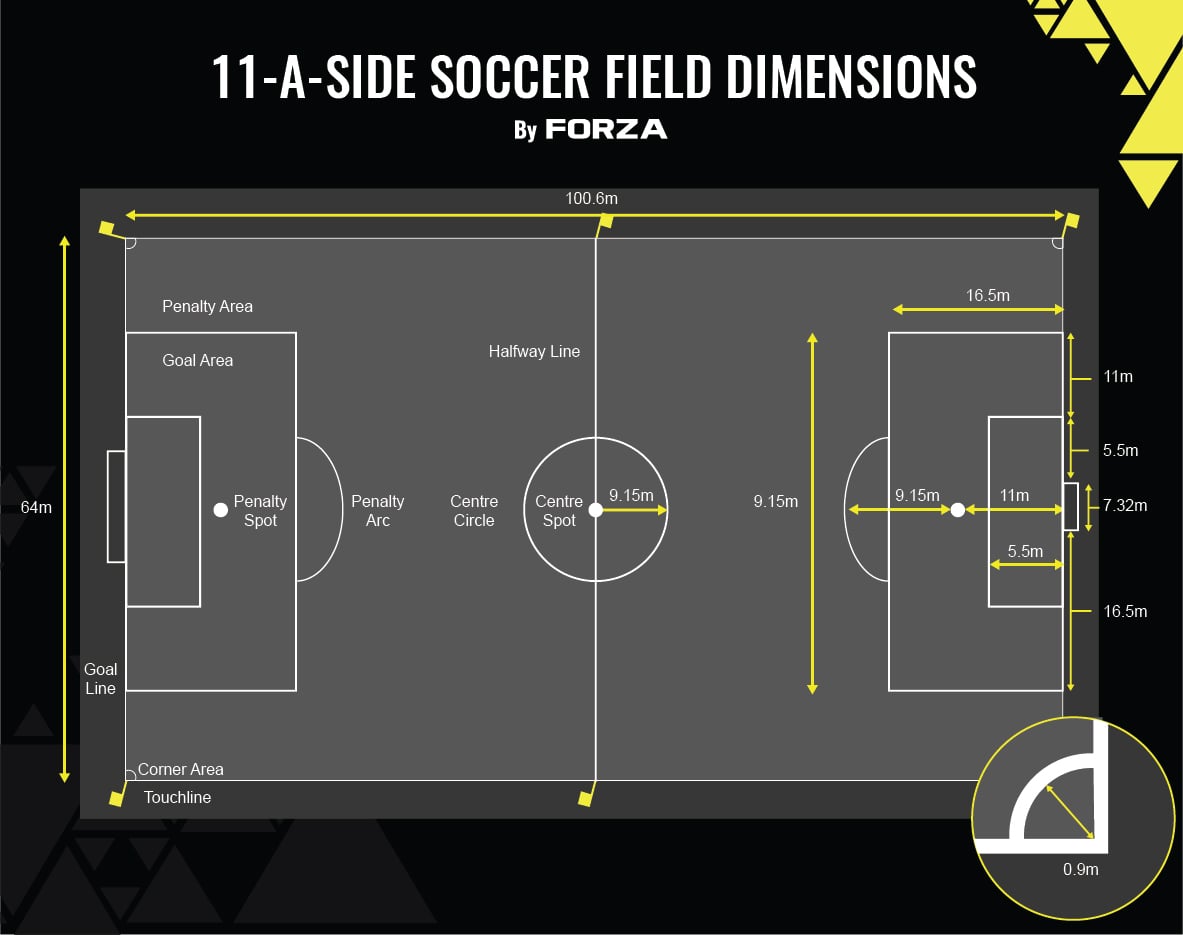
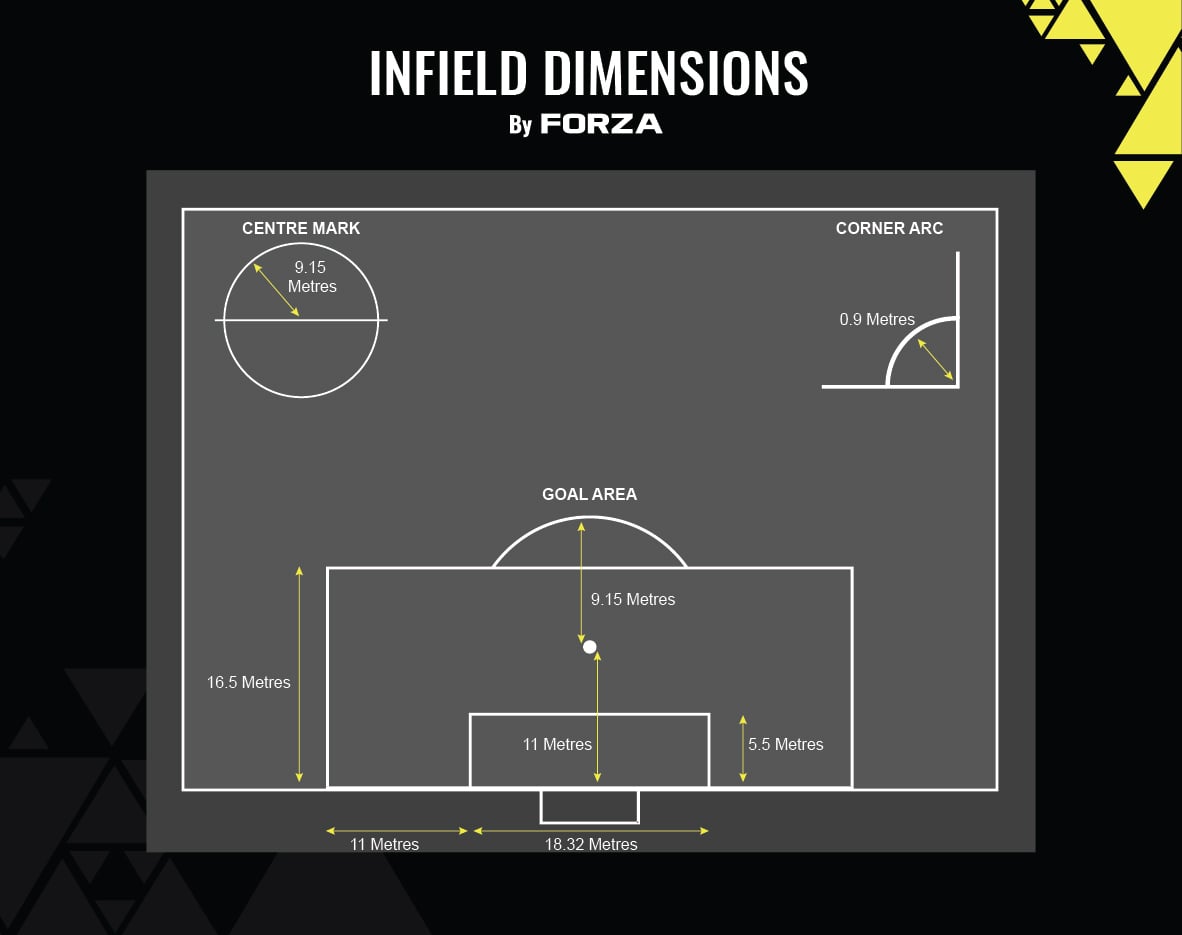
Regulated, UEFA, FIFA and A-League soccer games, always have the same size penalty boxes, corner arcs and centre circles, regardless of the length and the width of the field. The centre circle has a 9.15m radius, and is kept consistent to keep the defending team from being too close to the ball at kick-off. The penalty box extends 16.5m from the goal line, the corner arc is 0.9m in radius and the penalty spot is 11m from the goal line.
11-A-SIDE SOCCER FIELD LINES EXPLAINED
Field markings and lines are essential to the game and the rules, literally shaping the sport of soccer. For example, they show if the ball is in or out of play, and allow the spectators, coaches and players to follow the game. The official soccer fields in Australia must adhere to rules in regards to the size and dimensions of the infield markings, as well as the field perimeter - width and length.
All lines need to be marked out with a thickness of 12cm or thinner. Football Australia rules also state that all of the lines should be the same width, as consistent lines help maintain fairness and visibility.
The Soccer Pitch Perimeter
The perimeter of a soccer pitch is marked by touchlines along the length of the field, and goal lines across the width - inline with the goalposts. The entire ball has to cross either a touchline or a goal line to be deemed out of play. The entire ball must gross the goal line within the goal posts and under the crossbar to be deemed a goal.
The Goal Area
The goal area is the name for the small rectangle that is marked out in front of both goalposts. The goal area is 5.5m (6yds) out from the goal, and 18.3m (20yds) wide. Goal kicks are taken from within the goal area. If the defending team is awarded a free kick inside their goal area, the free kick can be taken from anywhere within the goal area. If the game is stopped for any reason other than a foul or misconduct - then it is started with a dropped ball. For example, if the game stops due to an equipment malfunction, or because a player is injured but has not been fouled, then a dropped ball is normally used to restart play. If the ball is within the goal area when play is stopped, then the dropped ball - which is dropped between a player from each team by the referee and can’t be kicked until it bounces - takes place on the edge of the goal area; i.e. 5.5m (6 yards) from the goal line.
The Penalty Box
Sometimes called the “penalty area” or the “18 yard box”, the penalty box is actually rectangular, not square as the name might imply. The penalty box has one line which runs across the width of the pitch and parallel to the goal lines - 16.5m (18 yards) from the goal. The total width of the penalty box is 40.3m (44 yards), extending 16.5m (18 yards) on each side of the goal posts.
The goalkeeper is allowed to handle the ball anywhere in the penalty box. If a foul is incurred inside the penalty box by the defending team, then a penalty kick is awarded and taken from the penalty spot. The exception to this is when an indirect free kick is awarded for a less serious or dangerous foul like impeding the progress of a player.
Penalty Spot
If a defending player commits a ‘serious’ foul when inside the penalty box, or handles the ball, a penalty kick, rather than a direct free kick is awarded to the attacking team.
The ball is played on the penalty spot, also known as the “penalty mark”, when a penalty kick is taken. The penalty spot is 11m (12 yards) out from the goal line, and is in line with the centre of the goal. The penalty spot itself should be 23cm (9 inches) in diameter.


Penalty Box Arc
Sometimes called “the D”, the penalty arc is marked just outside, and joins onto the penalty box. It curves around the top of the penalty box, with the furthest point of the arc 9.15m (10 yards) from the penalty spot. The arc is NOT considered part of the penalty area. The arc only comes into play when a penalty kick is awarded - during a penalty kick only the goalkeeper and the penalty taker can be inside the penalty box and the penalty box arc. All other players have to stay outside the arc and the penalty area until the kick is taken.
Halfway Line
The halfway line runs across the full width of the soccer field. It splits the field into two equal halves. The halfway line should be equal distance from each goal and goal line. For example, if a soccer field is 100m long, the halfway line will be marked at 50m.
The half of the field a player’s team’s goal resides in - i.e. the goal the team is defending - is often referred to as “his/her half” or “their half” of the field. At kick off - at the start of a match, after half time or after a goal is scored; players have to start in their own half of the field. Players can’t be offside if they are within their own half of the field.
Center Circle & Center Spot
The centre spot is marked in the exact centre of the field, directly on the halfway line. The centre circle is marked out around the centre spot, with a radius of 9.15m (10 yards).
At kick-off, the opposing team - i.e. the team not taking the kick off, has to stand outside the centre circle and in their own half of the field. Players from the team taking the kick off, can stand anywhere inside their half of the field, including inside the centre circle.
Corner Arc
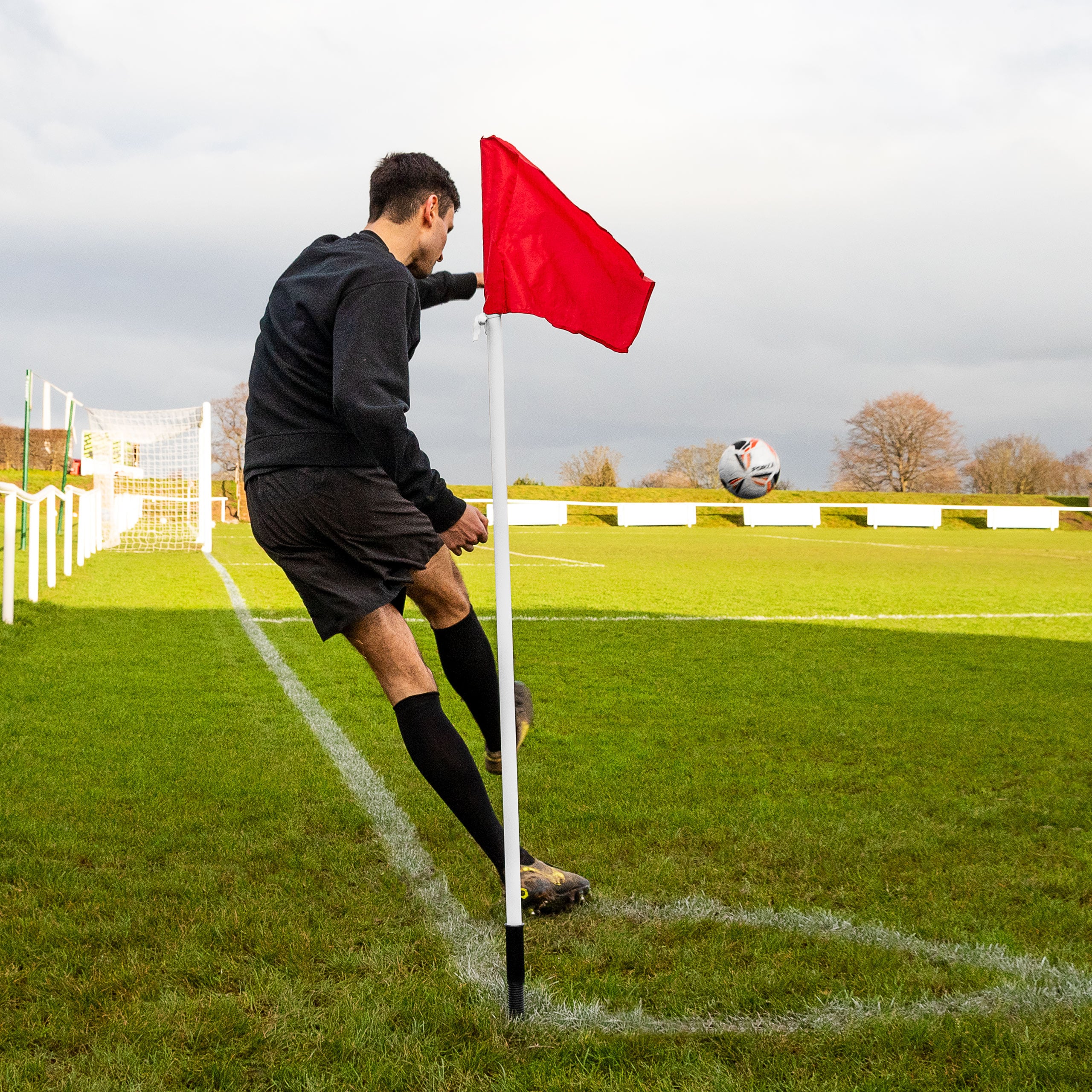
The corner arc dictates where corner kicks must be taken from. Each arc is the shape of a quarter circle and has a radius of 0.91m (1 yard). The corner arc is measured from the base of the corner flag at each corner on the field.
FAMOUS SOCCER FIELD DIMENSIONS
Y may be interested to know the dimensions of some of the most well-known soccer fields across the world. The table below shows the differences between famous soccer fields:
| Famous Soccer Field Dimensions | |||||
|---|---|---|---|---|---|
| Club | Ground | Location | Length | Width | |
| Manchester United | Old Trafford | Manchester (UK) | 105m (114.8yds) | 68m (74.4yds) | |
| Liverpool | Anfield | Liverpool (UK) | 101m (110.5yds) | 68m (74.4yds) | |
| Wrexham | The Racecourse | Wrexham (UK) | 102m (111.5yds) | 68m (74.4yds) | |
| N/A | Wembley | London (UK) | 105.2m (115yds) | 68.6m (75yds) | |
| Sydney FC / Australia NT | Accor Stadium | Sydney (AUS) | 105.2m (115yds) | 68.6m (75yds) | |
| Melbourne Victory | AAMI Park | Melbourne (AUS) | 105m (114.8yds) | 68m (74.4yds) | |
| Real Madrid | Santiago Bernabéu Stadium | Madrid (Spain) | 105m (114.8yds) | 68m (74.4yds) | |
| Barcelona | Camp Nou | Barcelona (Spain) | 105.2m (115yds) | 68m (74.4yds) | |
SOCCER FIELD FAQS
In this section, we will answer some of the most common questions regarding soccer fields and topics related to soccer and soccer fields.
How many players are on the field for soccer?
At any one time, there are normally 22 players on a soccer field - 11 from each side. If a team has a player sent off however, they will play the rest of the game with 10 players.
If a team gets more than 4 players sent off in one game - the match is abandoned. If the players were sent off due to misconduct, then either the opposite team is awarded the win, or the result could be determined by a disciplinary review.


How big is the world cup soccer field?
The size of a world cup soccer field depends on where the match is played. The size has to meet FIFA’s official regulations for international matches - 105m x 68m. Some small amount of variation is usually tolerated.
How many acres are in a soccer field?
A FIFA international soccer pitch, as mentioned above, is 105m x 68m - which gives a total pitch area of 7140m² - which is equal to 1.764 acres.
How many square feet is a soccer field?
A FIFA international specification soccer pitch measuring 105m x 68m, has a surface area of 7140m² and 76,835ft²
Why do they wet the field before a soccer game?
Groundskeeper will often apply water to natural grass and hybrid soccer fields for safety and performance reasons. One of the main reasons relates to player safety - as a watered pitch is softer and can help reduce the impact of falls. The moisture will also reduce friction meaning the ball will tend to travel faster across the grass, and regular watering also keeps the grass healthy.
What type of grass do they use for soccer fields?
Perennial ryegrass is the most popular grass for soccer fields as it is highly durable and grows quickly. In warmer climates, bermudagrass varieties are sometimes used to tolerate high temperatures better. Platinum TE Paspalum grass is used in many Arab countries for soccer pitches, whilst many professional soccer fields now use a hybrid system which typically consists of 95% natural grass - usually perennial ryegrass, and 5% artificial fibres. The hybrid system is more robust and easier to maintain than 100% natural grass.


Why is a soccer field called a pitch?
The term "pitch" comes from the verb - to pitch - meaning to set up or mark out. Cricket existed long before soccer was codified in England, and the stumps in cricket would have to be "pitched" to set up the cricket field. From this verb, the term "cricket pitch" developed, and in turn, when soccer was played in Cambridge university in the 1800s, the field was also called "a pitch".
What soccer field and ground equipment do you need for a regulation game?
Compulsory equipment for a regulated game includes 4 corner flags, soccer goal posts that meet the regulation size - 2.44m x 7.32m (8ft x 24ft) for senior 11 a side games. Many professional leagues will also require the ground to have dugouts/team shelters, and first aid kits must be available.
Pitch Perfect – Every Game, Every Level
Whether you are coaching Miniroos, or setting up a school soccer field, we hope our guide has proven helpful. From Under 6 games to 11-a-side international fixtures, you now know the correct dimensions and field markings. Using the official guidelines for soccer field dimensions and infield markings, you can mark out your pitch with confidence, ensuring safe, fair and enjoyable play.


