Dartboard Heights, Dimensions, Distances & Setup
Learn How to Set Up Your Own Oche to Play Darts at Home
Darts is a game that blends skill, precision and a healthy dose of competition. Invented in medieval England, whether you are playing casually in the garage or seriously in a team, darts is great fun and requires a high level of focus and concentration that helps to clear the mind.
No matter your age or fitness level, all adults can enjoy a fun or serious game of darts. Whilst it's traditionally played in pubs, many players are now enjoying solo and social games of darts in their homes.
Whether you are setting up an area for playing darts at home, or you’re a pub landlord looking to create a fun and social activity for punters; choosing the right dartboard, darts equipment, and getting the dimensions correct is essential. This is especially true if you’re looking to compete in regulated tournaments with official rules and dartboard setup. Having a practice dartboard that is the incorrect height for example, is likely to impede your performance in a regulated competition.
In this guide we will cover everything that you need to know about dartboards. From picking the right dartboard, to marking out the oche and playing your first game.

Choosing Your Dartboard
When buying your first dartboard, the best place to start is by thinking about where you’ll be playing. If the board is mainly for casual games at home, there’s no need to invest straight away in a tournament-grade board. That’s not to say a premium dartboard isn’t worth buying if budget allows, but for beginners the difference in quality often isn’t as noticeable. Once you’ve mastered the basics, you might decide to upgrade, but when you’re testing the waters, an affordable option is usually the best choice.
The PINPOINT Classic Tour Dartboard is an excellent entry-level board. It features slim wiring, high-visibility colours, and a surface made from premium sisal bristles. Easy to mount with the included hanging kit, it’s ideal for beginners or as a reliable training board for clubs.
For those seeking a higher standard board, the PINPOINT Professional Dartboard offers tournament-grade quality. Constructed from Brazilian sisal with ultra-thin wiring, it reduces bounce-outs and creates slightly larger scoring areas compared to the Classic Tour. These small details can make a big difference in top-level play, or for anyone striving to improve at a high level.
Brazilian sisal fibres for example, are naturally dense and tightly packed. This creates a firmer playing surface, allowing darts to stick securely without wobbling or bouncing back out of the board. In addition, the top-quality sisal is self-healing, and the natural elasticity allows the fibres to close up and eradicate any holes created by darts penetrating the surface.
Whilst serious darts players will be interested in the dartboard's specifications, not every buyer is focused purely on performance. Some people choose a professional dartboard for its look as much as its function. A well-made board, paired with a smart darts cabinet, can serve as a centrepiece in a games room or even a backyard pub, giving the space a polished, authentic pub feel.
At Net World Sports, you can buy both the Classic Tour and the World Series Dartboards as part of a set with the PINPOINT Darts Cabinet, perfect for combining quality play with a stylish finish.
Dartboard Size & Dimensions
A regulation dartboard, has a diameter of 45.1cm (17¾ inches); although this is often rounded up to 45.7cm (18.0 inches). This makes the circumference of a dartboard between 141.64cm and 143.63cm.
The thickness of the dartboard - i.e. how far it protrudes from the wall is 3.81cm (1.50 inches).
Dartboard Height
To ensure consistency, all dartboards should be set up at the same height. The correct setup places the bullseye (the centre of the board) at a height of 173cm from the floor.
Throwing Distance - The Oche
The oche is the name given to the line which dictates where players should stand behind when playing darts. The oche should be positioned 237cm from the dartboard face when throwing.
In theory this line could be marked in several ways - with a strip of tape or a rubber strip for example. However the most common method is to install a darts mat with the lines displayed upon it. A mat will also serve to protect the floor if any darts fall short, or bounce off the board.
If the floor is uneven, this isn’t really an issue - you can measure from the bullseye diagonally to the oche line using an electronic measurement tool or a tape measure. The diagonal distance from the throwing line/oche to the bullseye should be 293cm.
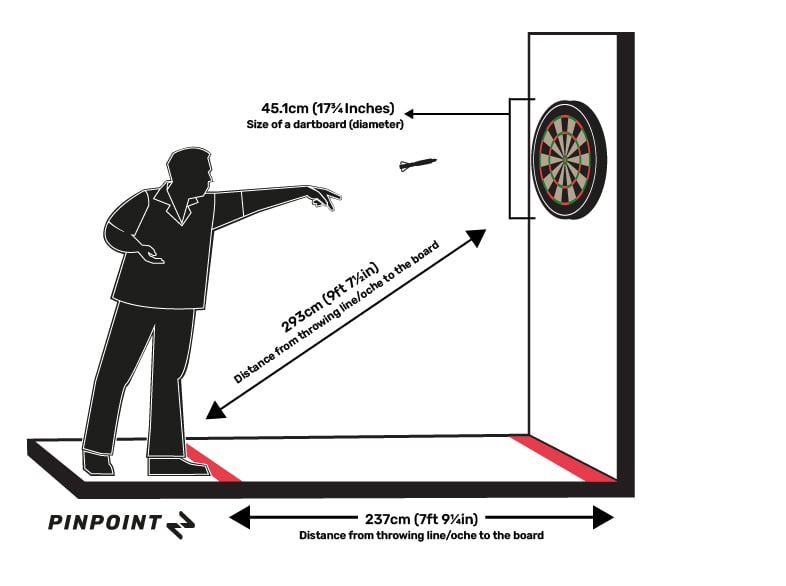
For safety reasons, there should be a 61cm (24 inch) space to the side of the dartboard to avoid injuries and any potential damage a wayward dart might cause to walls, furniture and windows. Steel tip darts are extremely sharp and can cause considerable damage; so the 61cm ‘safety margin’ is an important consideration.
The distance from the dartboard for the oche is usually the same for both men and women. However, there are a few tournaments and leagues that allow for beginners and sometimes juniors and/or women to stand slightly closer to the dartboard. A closer distance is often used for training purposes and to make the game more enjoyable for younger players or complete beginners who can’t reach or hit the board from the official distance of 237cm.
Alternative throwing distances vary but commonly include 228.6cm and 213.3cm - which in imperial measurements equate to 7ft 6 inches, and 7ft respectively.
| Match Type | Metric Distance | Imperial Distance |
|---|---|---|
| International Steel-Tip Matches | 237 cm | 7 ft 9¼ in |
| Juniors Matches | 229 cm | 7 ft 6 in |
| Soft-Tip (Electronic) Matches | 244 cm | 8 ft |
| Additional Practice Line | 259 cm | 8 ft 6 in |
Mat includes four printed throw lines plus an extra line for extended practice.
Professional Rubber Mat Darts Oche
Whilst international tournaments will have a permanent stage setup made with raised wood and sometimes metal, using a professional-quality rubber mat darts oche is the best option for most pubs, clubs and homes. At a fraction of the cost of a permanent setup, an oche darts mat provides a range of benefits compared to makeshift alternatives like tape, chalk marks and floor stickers.
A high-quality mat, made of heavy-duty rubber with a quality construction, ensures that the mat will remain firmly in place. This in turn will provide a consistent and accurate throwing line that won't shift, and is unlikely to wear down with repeated use for a number of years.
In addition, unlike temporary markers the mat won't fade or peel, and so won't require a repeat application of any sort. In addition, a rubber mat will also protect the floor from dropped darts and darts that rebound off the board or walls. With official lines integrated into the design, the PINPOINT Oche Mat can be used for both practice and competition.
| Feature | Benefit |
|---|---|
| Construction | Professional dartboard mat with full-length integrated oche. |
| Material | Thick, heavy-duty rubber for long-lasting use. |
| Protection | Helps protect floors and darts from damage or breakages. |
| Portability | Easy to roll out for play and roll up for storage or transport. |
| Cleaning | Wipe clean with a damp cloth to remove dirt or debris. |
| Suitable For | Home use, pubs, dart clubs and more. |
Setting Up Your Dartboard
Creating the perfect setup will not only protect your space and make the game safer in general, it will also give you a more enjoyable and authentic playing experience.
-
Fixing the Dartboard
- Mount the dartboard securely to a solid, flat wall — plasterboard or thin partitions aren’t ideal, as repeated impacts may loosen fittings.
- Use strong wall fixings (screws and wall plugs or a mounting bracket) to keep the board stable and prevent wobbling.
-
Choosing the Location
- Select a space that’s quiet and low-traffic — you don’t want people walking through your throwing lane.
- Avoid areas close to windows, mirrors, or fragile décor, as even a stray dart could cause damage.
- Allow at least 8–10 feet of clear floor space from the board to where you’ll be throwing.
-
Protecting Your Walls & Floors
- Add a backboard, surround, or dartboard cabinet to protect the wall and give a clean, professional look.
- Use a darts mat or rug to protect flooring and soften drops/bounce-outs.
-
Lighting the Area
- Ideally use a spotlight or LED strip angled to avoid shadows on the board.
- Avoid harsh overhead lights that can create glare.
-
Setting the Correct Measurements
- Bullseye height: 5 ft 8 in (1.73 m) from the floor.
- Throw line (oche) distance: 7 ft 9 ¼ in (2.37 m) from the face of the dartboard (not the wall). Mark it with tape, a mat, or a fixed oche.
-
Finishing Touches
- Keep a scoreboard (chalkboard, whiteboard, or digital scorer) nearby.
- Personalize with team colors, dart cases, or pub-style décor for atmosphere.
Scoring & Number System
The dartboard’s numbered layout is designed to reward accuracy and punish inaccuracy. The score is generally represented by the number above or below the section the dart landed in. For example, if the dart lands in the centre but above the bullseye - then the score would be 20 points if the dart lands in the black section.
- Inner Bullseye (red): 50 points
- Outer Bullseye (green): 25 points
- Thin Outer Ring (red or green): Score is doubled
- Thin Inner Ring (red or green): Score is tripled
Mastering the doubles and trebles is the key to scoring efficiently and improving your game.
Popular Dart Games
For most players, darts isn’t just about hitting high scores, it’s about having fun with family and friends. With this in mind, there are a variety of different games you can play to keep things interesting and challenging. From fast-paced scoring challenges to strategic games - the table below outlines some of the classic darts game formats.
| Game | Players | Objective |
|---|---|---|
| 501 | 2+ players | Each player starts at 501 points and subtracts scores each turn. First to reach exactly zero, ending on a double, wins. |
| 301 | 2+ players | Like 501 but starting from 301 points. Faster-paced and beginner friendly. |
| Cricket | 2 players or teams | Hit numbers 15–20 and bullseye three times each to close them. Score points until both sides close the same numbers. |
| Around the Clock | Any number | Hit numbers 1–20 in order, then finish on the bullseye. |
| Killer | 3+ players | Hit your chosen number to become a Killer, then aim at opponents’ numbers to knock them out. |
| Halve-It | 2+ players | Score only on set targets each round. Missing halves your total score. |
| Shanghai | 2+ players | Throw at one number per round (1–20 in order). A Shanghai (single, double, treble in one turn) wins instantly. |
These classic dart games suit all levels of play, from casual fun to serious competition.
Dartboard Accessories
Having a complete darts setup that looks great and has all the right elements for competitive games means that you may have to invest in more than just the dartboard itself. For example, you may wish to use a dedicated dartboard light or overhead spotlight to eliminate shadows and make the numbers easier to read.
As discussed above, wall protection in the form of a dartboard cabinet or a dartboard surround can help prevent damage to the wall next to the board. Buying the right type of darts can also make a big difference to the consistency of the flight and in turn your enjoyment of the game. At Net World Sports you can choose from affordable moulded darts, brass darts and professional- quality tungsten darts.
Your Dartboard, Ready for Action
Setting up a dartboard is simple, but small details can make all the difference. Correct measurements, solid fittings, and good lighting will give you a setup that feels authentic and enjoyable. Add a backboard or cabinet for style and protection, and you’re ready to go. All that’s left to do is step up to the oche, take aim, and enjoy the game.