Hockey Field Dimensions & Markings Guide
Hockey Field Size, Dimensions & FAQ Guide
Whether you’re playing at a school, a local club or for a professional team, the size of the hockey field matters. Also commonly called a "hockey pitch", a correctly marked out field, is vital for an enjoyable, regulated game. The field and its dimensions are pivotal factors when it comes to setting the pace of play, the tactics on show and general gameplay. A hockey field that falls short of standard can slow the game, confuse players and increase the risk of injury.
This guide explains the official field hockey field dimensions used in Australia and set by the International Hockey Federation (FIH). We also look at how hockey fields have changed, what the lines represent, and why some surfaces are blue and watered before play.
The History of Hockey Fields
As you might expect, hockey began on grass. Whilst similar games with curved sticks and balls have been played for thousands of years in countries like Egypt, it was in the 1840s that public schools like Eton played the first officially organised and codified versions.
The first hockey club to be formed was Blackheath (located in southeast London). Whilst the first hockey association was formed in 1886, it wasn't until the early 20th century that the first fields were standardised at 91.4 m × 55 m (100 yards × 60 yards).
In 1998, official hockey measurements shifted from imperial to metric; though some national organisations still use the older system. More recently, top-level fields have often been made blue to improve visibility on television. Advances in artificial turf have also refined playing surfaces, and greater attention is now given to runoff areas to improve player safety.
Water-based fields remain the gold standard for international and elite field hockey. However, whilst water-based fields are overwhelmingly prevalent in the highest tiers of the sport, some high-level teams still play on sand-based or sand-filled fields.

Dimensions of a Hockey Field
Official Hockey Regulation Field Size
Hockey Australia is the official governing body for hockey in Australia, and they use the field dimensions set out by the FIH. The hockey field - known as the ‘field of play’ in official literature and documentation, should measure 91.40m in length and 55m in width.
Beyond the field of play, extra space is required for safety reasons. This extra space and margins around the field perimeter are called the "run-off areas". These areas are required to be a minimum of 3m behind the backlines and 2m along the side lines, plus an additional 1m of hard standing for both areas. The safest option that is recommended for all fields, is wider still: 4m-5m. The total playing area covers more than 5,000 square metres.
Here is a list of some of the most important dimensions:
- Length of sidelines: 91.4m
- Width of backlines 55m
- Run-off at sidelines: minimum 2m
- Run-off at backlines: minimum 3m
- Total field area 5,027m²
- Striking circle radius: 14.63m
A hockey field with full (recommended) run-offs occupies about 6,388 m². For comparison, a standard 105 × 68 soccer pitch with recommended run-off typically needs ~8,200–8,600 m², depending on whether you use 3 m or 4 m clearance.
You can use the table to compare hockey fields and pitches with rugby union, rugby league, soccer, and Aussie Rules. It shows each sport’s common elite-level size (some allow for variations) and, where relevant, the total surface area with recommended safety margins.
For hockey, this includes run-offs.
For rugby union and rugby league, it includes the in-goal areas.
For soccer, the reference is 105 × 68 m with 3–4 m of perimeter clearance.
Aussie Rules uses an oval with no fixed dimensions but falls within a range of 135–185 metres (148–202 yd) long and 110–155 metres (120–170 yd) wide.
| Field Sizes & Areas – Hockey, Rugby Union, Rugby League, Soccer, Aussie Rules | |||
|---|---|---|---|
| Sport | Dimensions (m) | Area (m²) | Notes |
| Hockey (with full run-offs) | 101.4 × 63 | 6,388 | FIH field (91.4 × 55) + run-offs (+5 m ends, +4 m sides) |
| Rugby Union (overall) | 144 × 70 | 10,080 | 100 m field + 22 m in-goal each end; max width 70 m |
| Rugby League (typical overall) | 120 × 68 | 8,160 | 100 m field + ~10 m in-goal each end; width 68 m (in-goal can vary 6–11 m) |
| Soccer / Association Football | 105 × 68 | 7,140 | Common elite size within IFAB range (100–110 × 64–75) |
| Aussie Rules (oval) | ≈160 × 141 | ≈17,700 | Approx. ellipse area (πab/4); venues vary widely (~15,000–22,000+ m²) |
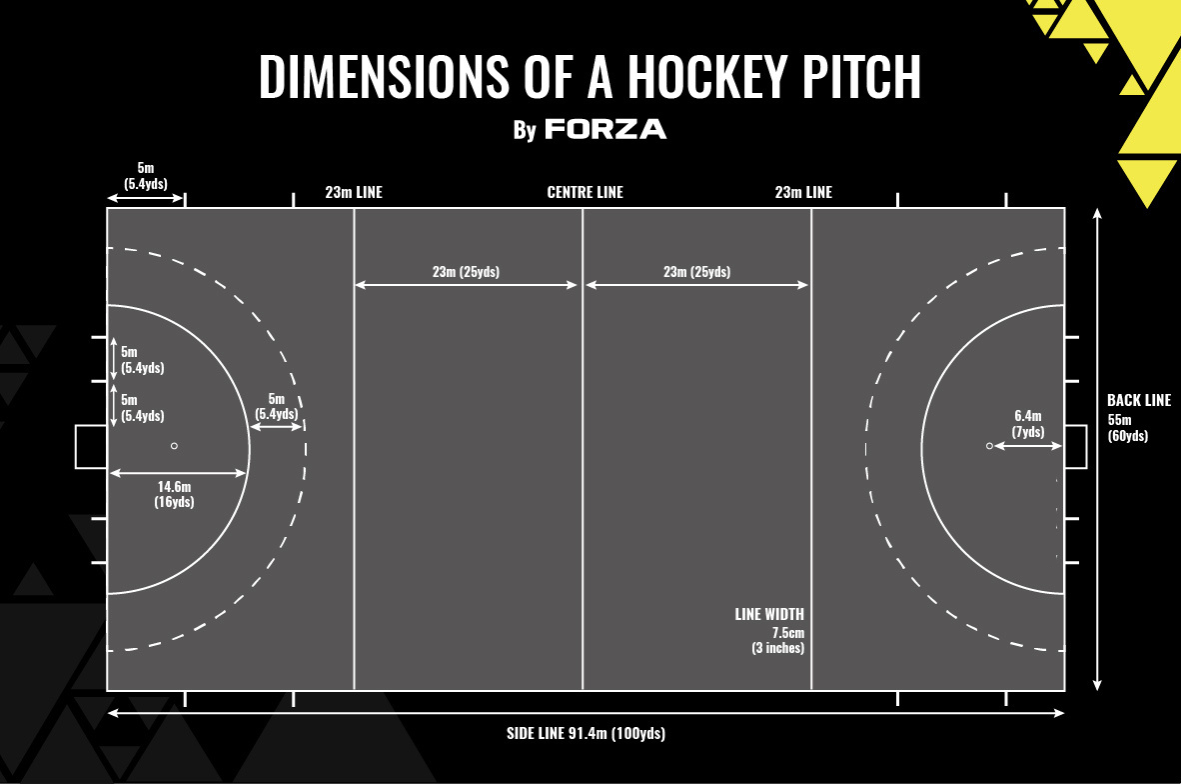
Below is a labelled diagram of a regulation hockey field. It shows the field of play only: 91.4 m by 55 m. Key markings are highlighted, including the centre line, the 23 m lines and the striking circles. Dimensions appear in metres with yard conversions. Run-off areas sit outside this graphic and are not included.
Youth Hockey Field Sizes
At junior and grassroots level, smaller fields are the norm; they keep the gameplay tight, cut the running and give young players more touches per game to help develop skills and enjoyment of the sport. Teams are often small-sided—5s, 6s, 7s or 9s—so everyone stays involved. For games with players under the age of 10, coaches will often split a full field into two or three mini fields.
Field markings for kids' games are usually simplified with a shortened scoring circle, a single penalty mark and scaled 23-metre lines where required. Goals are reduced to suit age and ability, and sometimes there are no goalkeepers. See our hockey goal guide for more specific information.
Whilst programmes such as Minkey and Hookin2Hockey exist to provide guidelines for youth hockey in Australia, there isn’t a single national standard for field sizes. With this in mind, schools, clubs and local and state associations publish their own guidelines, so always check the local and most relevant associations’ rules before permanently lining and setting up the field. For training, as with senior practice sessions, throw-down lines, cones and lightweight boards are used. As players grow, the formats step up until they reach the full 91.4 × 55 m field. The aim of this incremental approach is simple: safer games, better learning and more fun.
Hockey Field Markings & Lines
Understanding the various lines and markings on a hockey field is essential for players, coaching staff and officials. Every line has a purpose. Lines are 75 mm wide and must be clearly visible against the turf or surface of the field.
Some of the lines and markings include:
Field Perimeter Lines
Perimeter lines define the boundary of the field of play. They are 75 mm wide, count as part of the playing surface, and determine when the ball is out. They also fix where restarts happen and where the goals are set.
Side lines and Back lines
Side lines run the full length of the field, 91.4 m. Back lines run the width, 55 m, with a goal centred on each backline.
Centre Line (Halfway Line)
The centre line is the halfway line, just like in soccer. It splits the field into two equal halves and acts as the starting point for play. Incidentally, the start of play or restart at the centre point is called "push back" or "centre pass", which is the equivalent to "kick off" in soccer and rugby.
Each half begins with a push back / centre pass on this line, and play restarts here after every goal. At these restarts, all players must be in their own half, although there is no centre-circle like soccer fields. The ball can be played in any direction. Coaches use the line as a reference to set their formation, to reference when communicating gameplays to players, and to decide when to press towards the opposition's goal or to drop back from the action in a more defensive format.
It’s a simple stripe across the field, but it shapes how teams organise and it serves as an important reference point for the execution of certain gameplays and tactics.
23-metre Lines
The 23-metre lines are the two solid lines that sit 22.9 m from each backline. Many people just call them the “23s”. They run right across the field and help split the field into clear and distinct zones. They matter and exist primarily because of the special restart rules which exist within the attacking 23. From a free hit here you can’t play the ball straight into the circle. It must travel 5 metres first or touch another stick. Defenders must also give 5 metres of space for the free hit to be taken.
Long corners and many restarts are taken from the 23-metre line. Umpires use the line to fix the exact spot and to manage set plays around the circle.
Coaches use the 23s as tactical triggers and reference points. Teams will set a half-court press (defensive strategy where a team sets up its defense and applies pressure to the opposition around the halfway line) on their own 23, or go full press (defensive tactic where the entire team applies pressure to the opposition from their own goal line to the 23 metre line) when the ball is in the opposition 23. The lines are important for the implementation of a number of rules and they shape how sides defend, build and break.

Striking Circle
The striking circle is the scoring zone. It is effectively a “D” drawn in front of and around each goal. Picture a capital “D” in front of the goal. From each end, a smooth arc sweeps back to the backline, shaped as if you swung a giant compass 14.63 m from the inside face of each post. The painted line itself counts as part of the circle, so a ball touching it is “in.”
A goal only stands if an attacker touches the ball inside this circle. It can be a shot, a deflection or a glance off a stick. If the last attacking touch is outside, it does not count. Umpires watch the circle line closely to judge in-or-out, tips and rebounds.
The circle also sets the rules for keepers. Goalkeepers have full "goalkeeper privileges" inside it and are limited beyond.
5-meter Dotted Lines
The dotted line sits 5 metres outside the striking circle. During a penalty corner, if the ball travels beyond this line, the penalty corner ends. On fields without the dotted line, the rule applies, but is harder to judge, i.e. - once the ball goes more than 5 metres outside the circle, the penalty corner is over.
In the past, free hits awarded to the attack within 5 metres of the circle had to be taken back on the dotted line. That requirement was removed in 2015, so many new surfaces no longer mark it as it’s not a mandatory marking.
Penalty Spot (Penalty Stroke Mark)
The penalty spot sits 6.4 m from the goal line on the centre of goal. It is used for penalty strokes only, and is where the ball must be placed. The keeper must start on the goal line during a penalty stroke; the striker taking the penalty starts behind the penalty spot mark.
Corner marks and Backline Marks
Corner marks sit on the touchlines, 5 m from the backline. They show the spot for long corners. On the backline, small marks at 5 m and 10 m from the nearest post are used to set defenders at penalty corners. These marks sit outside the field of play.
Goals
Goals are fixed on the centre of each backline. The opening is 3.66 m wide and 2.14 m high. See
Field Hockey Positions Explained
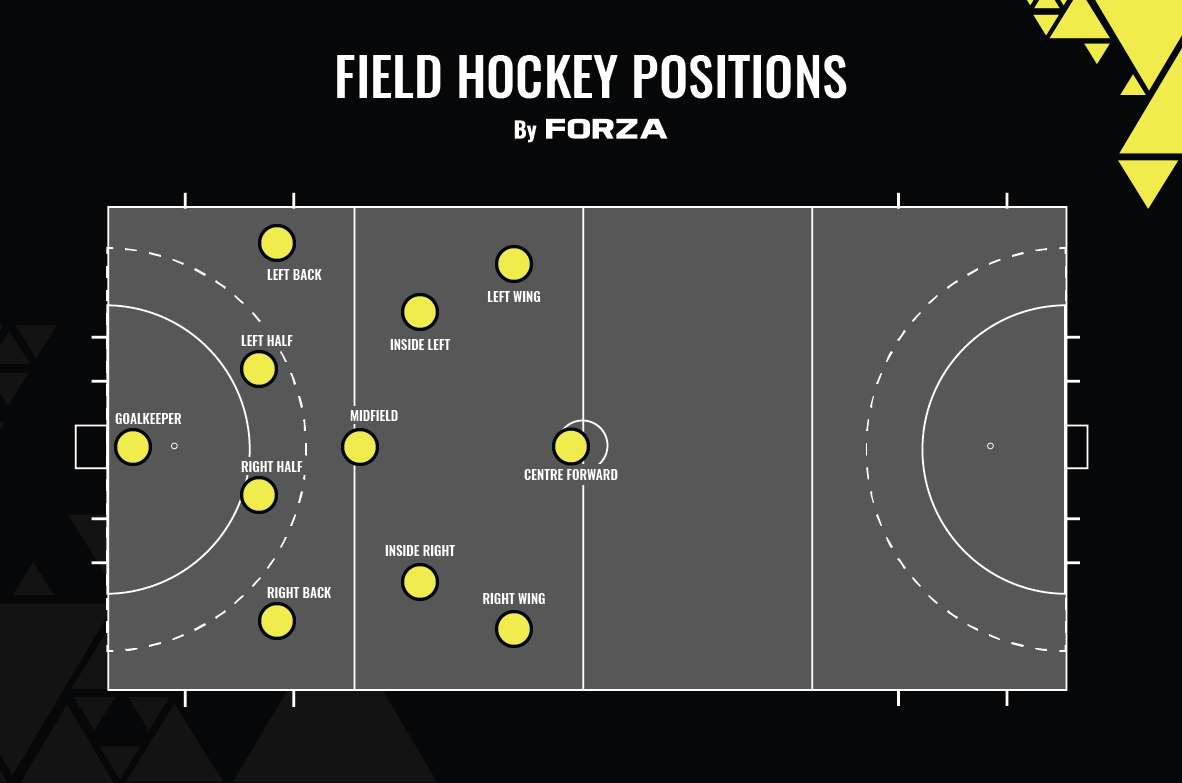
Understanding player positions is key to mastering field hockey tactics and it helps spectators to understand and follow the action. Each team lines up with 11 players, all with distinct roles:
Goalkeeper – The last line of defence, protecting the goal from opposition shots and preventing them from scoring.
Defenders (Left Back, Right Back) – Positioned nearest the goalkeeper, they focus on blocking attacks and clearing the ball from the defensive zone.
Halfbacks (Left Half, Right Half, Centre Midfield) – Link the defence and attack, supporting defenders while distributing the ball forward.
Inside Forwards (Inside Left, Inside Right) – Operate just behind the front line, creating scoring opportunities and pressing the opposition midfield.
Wingers (Left Wing, Right Wing) – Stretch the play wide, deliver crosses, and cut inside to take shots.
Centre Forward – The main attacking threat, leading the front line and aiming to score goals.
This traditional formation gives teams a balanced structure, ensuring coverage across the pitch while allowing quick transitions between defence and attack.
HOCKEY FAQS
How to set up for a penalty corner in hockey?
When a penalty corner is given, the attacking team will usually set up a rehearsed routine. The injector (attacker who takes/starts the penalty corner) pushes the ball in from the backline to a teammate at the top of the circle, known as the "stopper". The stopper cushions the pass and sets it for the striker or drag-flicker to shoot. Other attackers arc around the circle, ready to pounce on rebounds or deflections.
Before the injection/initial stroke of the penalty corner, every attacker must be outside the striking circle. For a goal to count, the ball must first travel outside the circle and then be brought back in before the shot. These steps keep the play ordered and give umpires a clear sequence to judge.

For the defending team, the goalkeeper will prepare for the shot and the first runner will rush out to block the initial hit. Other defending players defend the goal line, and other defenders position themselves outside of the circle to intercept passes and clear any deflections, passing/hitting them away from their team's goal. There is a maximum of 5 defenders that are allowed behind the backline, and all other defending players must wait behind the centre line until the inserter takes the penalty corner for the attacking team.

Why are hockey fields blue?
As mentioned earlier in the guide, hockey fields are sometimes blue to improve visibility of the ball for spectators and players. This is especially important during televised games. First implemented at the London 2012 Olympics, it reportedly helped viewers to follow the fast paced nature of the sport, which uses a relatively small ball. It also provides a unique visual to hockey, making it distinct to the sport, which can also help with the marketing and promotion of events and the sport in general.
Why are hockey fields wet?
The reason that hockey fields are wet is because groundsman and women typically add water to the artificial surface to reduce friction. This allows for faster and smoother ball movement as well as better player control during games, creating the ideal playing conditions for hockey (especially at professional levels). It is for this reason that most hockey fields used at international level are water based.
What are the different hockey field materials?
Hockey games can be played on a range of surfaces. Each surface has its own unique properties which in turn affects the speed, control, and overall style of the game. From elite-level water-based turf to community sand-filled fields, here are the main types of hockey field materials you’ll come across:
| Hockey Field Surface Types & Materials | ||
|---|---|---|
| Surface Type | Description | Typical Use |
| Water-Based Turf | Artificial surface kept wet to reduce friction. Fastest and smoothest ball movement. | International and elite competitions. |
| Sand-Based Turf | Artificial grass filled mainly with sand. Slower than water-based but durable. | Schools, community clubs, training. |
| Sand-Filled Turf | Heavier sand infill, less ball speed. Provides more grip but harder on players. | Recreational and multi-sport use. |
| 3G Turf | Artificial grass with rubber crumb infill. Designed for football and rugby. | Rarely used for hockey; unsuitable for elite play. |
| 4G Turf | Latest generation synthetic turf. No infill, longer fibres, low maintenance. | Mixed sports use. Limited uptake for hockey. |
| Astroturf (Generic) | Term often used for early artificial grass fields. Less advanced than modern turf systems. | Older facilities, training grounds. |
There is no right surface. The surface of a given hockey field will usually depend on the level of play, the budget available, and whether the field is used for other sports. For competitive hockey, water-based and sand-based turfs remain the preferred options, while newer 3G and 4G surfaces are better suited to football or rugby.
The Right Equipment for Every Hockey Field
Understanding hockey field dimensions and the field line markings is key to playing the game properly. Understanding the basics will also tend to help specators to follow and enjoy watching the sport more. At Net World Sports, we stock the full range of FORZA field hockey equipment — from hockey balls and hockey sticks to goals, training gear and field accessories. Whether you’re kitting out a school, a community club or a team, we’ve got everything you need to play, train and compete in hockey!